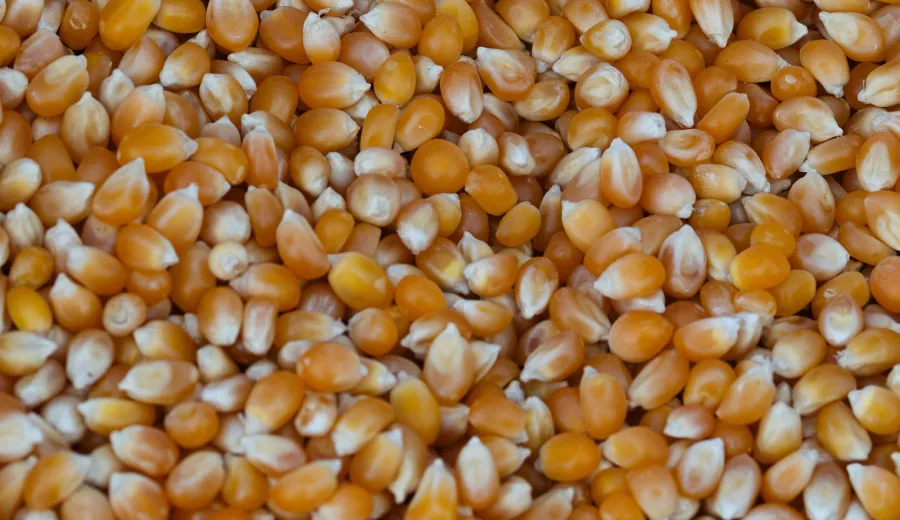
USA and Brazil account for the majority of European corn supply. Find GFSI-certified wholesale corn suppliers from both origins on Nutrada, filterable by GMO status and MOQ.
| Field | Detail |
| Botanical name | Zea mays |
| Available forms | Whole grain, cornmeal, polenta, grits, corn flour, popcorn |
| Origins | USA (Iowa, Illinois, Indiana), Brazil (Mato Grosso, Paraná), Argentina, EU (France, Romania, Hungary) |
| Certifications | GFSI, EU Organic, Non-GMO Project Verified, Kosher, Halal |
| Common applications | Polenta, breakfast cereals, tortilla chips, gluten-free flour blends, brewing adjunct |
| Packaging | 25-50 kg bags |
| MOQ | 25kg |
| Category | Grains Wholesale |
Different corn types serve distinct procurement requirements based on end-product specifications and regulatory compliance needs.
| Form/Grade | What it means for procurement | Typical application |
| Yellow dent corn | Most common industrial grade, GMO status varies by origin | Cornmeal, grits, animal feed, industrial starch |
| White corn | Food-grade specification, preferred for traditional European products | Polenta, tortillas, white cornmeal |
| Blue corn | Specialty grade with high anthocyanin content | Artisan tortillas, premium snack products |
| Sweet corn | Higher sugar content, different harvest timing | Canning operations, frozen vegetable processing |
| Popcorn corn | Hard pericarp with specific expansion properties | Snack manufacturing, popping corn ingredients |
| High-amylose corn | Industrial starch specification | Modified starch applications, pharmaceutical excipients |
Moisture content must not exceed 14% regardless of type. Non-GMO certification is mandatory for EU food applications where corn content exceeds 0.9% of the finished product.
USA dominates global corn production with Iowa, Illinois, and Indiana forming the primary supply corridor known as the Corn Belt.
Brazil has emerged as the co-leader in global corn exports alongside the USA, with both countries together accounting for close to 60% of world corn exports, Brazil's production centred in Mato Grosso and Paraná, Argentina's Pampa region contributing significant additional volumes, and Ukraine supplying European feed markets despite ongoing logistical disruption.
EU-origin corn from France, Romania, Hungary, and Germany provides non-GMO supply with simplified regulatory compliance for food manufacturers, though volumes remain limited compared to transatlantic suppliers.
French corn benefits from established non-GMO production protocols, while Romanian and Hungarian operations offer competitive pricing within single-market logistics networks.
Corn is hygroscopic and requires storage below 15 degrees Celsius with moisture content maintained under 14% to prevent mold development and mycotoxin formation. Standard packaging uses 25-50 kg woven polypropylene bags with moisture barrier linings. Shelf life reaches 18-24 months under proper storage conditions, dropping to 12-15 months in humid environments above 60% relative humidity. Confirm the latest mycotoxin panel results before ordering, corn requires testing for aflatoxin B1 (EU limit 5 µg/kg), deoxynivalenol (DON limit 1,750 µg/kg), and fumonisins B1+B2 (combined limit 4,000 µg/kg) per EU Regulation 2023/915.
EU-origin organic corn from France, Romania, and Hungary provides the most straightforward certification pathway, with established organic protocols and GFSI-certified supply chains. USA organic corn requires additional verification of non-GMO status alongside USDA NOP certification. Brazilian organic corn operations are limited but offer dual EU-USDA certification where available. Supply depth remains concentrated in European origins for organic specification.
Consumer formats include retail bags (500g-2kg), polenta meal boxes, corn flour sachets, and popcorn kernels in resealable pouches. Private label corn requires higher MOQs than bulk supply, typically 5-10 pallets minimum per SKU. Fix the moisture specification for your finished product before production starts, as different applications require different moisture targets for optimal shelf life and texture performance.
Corn processors concentrate in major producing regions, Iowa and Illinois for USA supply, São Paulo state for Brazilian operations, and Occitanie region for French production. Request comprehensive documentation including batch-specific CoA, complete mycotoxin panel results, and non-GMO certification where required for EU food applications.
Most EU food manufacturers source Wheat and corn from the same suppliers to streamline dual-grain procurement and reduce supplier qualification overhead.
Nutrada lists GFSI-certified corn suppliers from USA, Brazil, Argentina, and EU origins, covering whole grain, meal, grits, and specialty forms across conventional and organic supply. All orders are placed directly with certified suppliers, with no intermediary.
Last updated: Apr 6, 2026

Find the right supplier for your food ingredients in under a minute with Nutrada. Nutrada - Sourcing made easy.