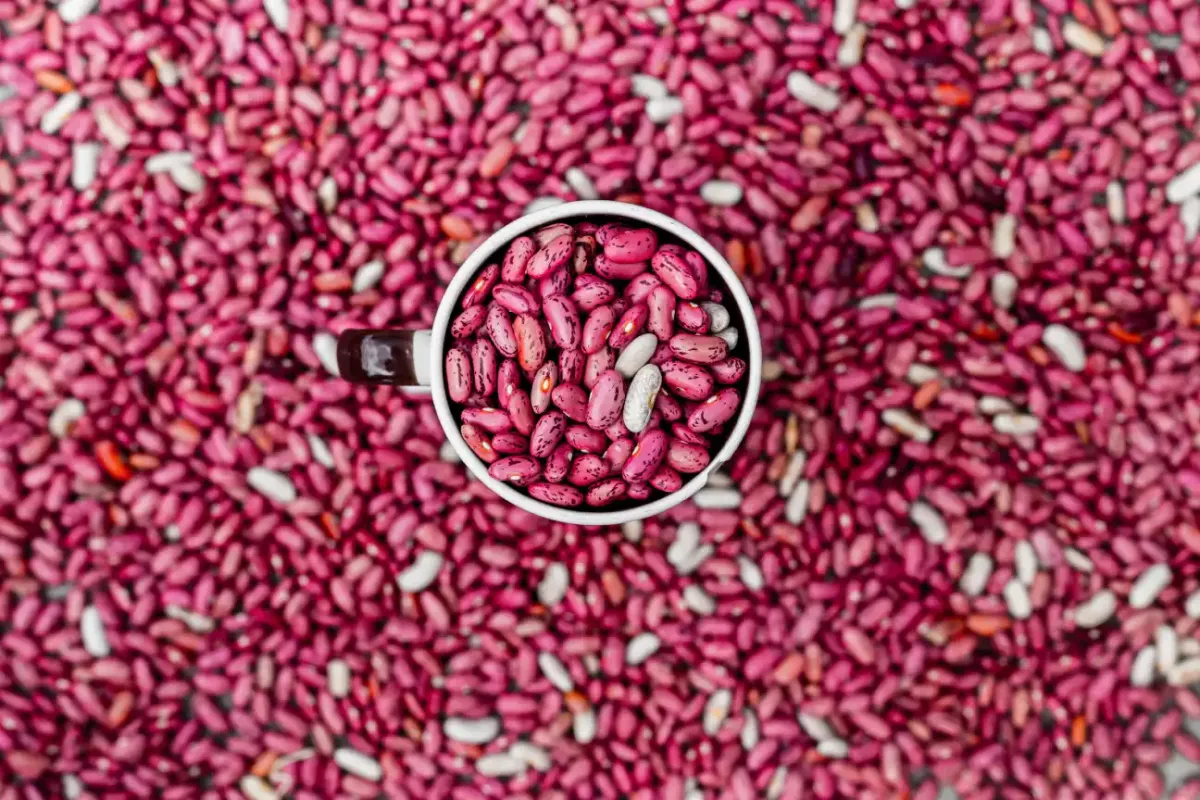
Dry beans (Phaseolus and Vigna species) are one of the highest-volume traded pulse categories, with global production exceeding 27 million metric tons annually. For food manufacturers, the commercially relevant types include kidney beans, black beans, navy/haricot beans, pinto beans, cannellini, mung beans, and faba beans. Sourcing decisions depend on the end application, protein content, cooking behaviour, and compliance with EU import requirements.
In short:
Eight bean types account for the bulk of European food manufacturing demand. Each serves different applications, and origin choice affects both price and quality consistency.
| Bean Type | Protein | Key Applications | Main Origins |
| Navy (haricot) | 20–23% | Baked beans, canning | Canada, USA |
| Red kidney | 22–25% | Canned beans, chili, bean salads | Canada, USA, China, Argentina |
| Black beans | 21–23% | Ready meals, burritos, plant-based products | Argentina, USA, Myanmar |
| Cannellini | 20–22% | Mediterranean dishes, premium retail | Italy, Argentina, Egypt |
| Butter beans (lima) | 19–21% | Soups, salads, Mediterranean dishes | Greece, Egypt, Madagascar |
| Mung beans | 22–25% | Plant-based egg alternatives, protein isolates, Asian cuisine | Myanmar, China, India |
| Faba beans | 26–30% | Protein isolates, meat alternatives, animal feed | UK, France, Australia, Baltic states |
| Pinto | 20–23% | Refried beans, Tex-Mex products | USA, Mexico, Canada |
Mung beans are increasingly important beyond traditional Asian applications. They are a key raw material for plant-based egg alternatives and protein isolates, driving significant demand growth from European food tech companies.
Faba beans have the highest protein content of the common bean types (26–30%) and are gaining traction as a pea protein alternative in European plant-based food manufacturing, partly because they can be grown domestically in the EU.
Red kidney beans are the backbone of canned bean products across Europe: baked beans, chili con carne, and bean salads all rely on kidney beans as the primary ingredient. They are commercially available in dark red and light red varieties, with dark red having a slightly higher price for visual appeal. Key origins include China, Canada, and Argentina, with quality and price varying significantly between them.
Navy beans (haricot beans) are the classic baked bean. British and Northern European canning operations source primarily from North America (Canada, Michigan, and Nebraska in the US) where the cool-climate growing conditions produce beans with consistent size, colour, and hydration properties, critical for an even cook during canning. Canadian navy beans have long been the benchmark for European canned bean manufacturers.
Black beans have moved from a niche Latin American ingredient to mainstream European use over the past decade. Ready meal manufacturers, burrito and wrap producers, and the growing market for plant-based protein bowls all drive demand. Myanmar and China are the dominant origins for European supply, with Myanmar offering particularly competitive pricing.
Cannellini and butter beans serve the Mediterranean and premium retail segments. Italian and Greek origins are more costly due to authentic positioning, but Argentina and Egypt produce equivalent quality at lower prices for food service and private label.
Faba beans (Vicia faba) are an interesting outlier that deserves specific attention. While not a Phaseolus species, faba beans are increasingly relevant to European food manufacturers because they can be grown domestically across much of Northern Europe: France, the UK, Germany, and Scandinavia all have significant faba bean production. This makes them attractive for “locally sourced” and “European origin” positioning on labels, which several major retailers now actively incentivise in their procurement policies.
Mung beans have moved beyond their traditional role in Asian cuisine to become a significant protein ingredient source. Mung bean protein is now used in several high-profile plant-based egg and meat alternatives sold in European retail. The whole bean is also growing in European food service: Buddha bowls, grain salads, and sprouted bean products all drive demand. Myanmar, India, and China are the primary origins, with Myanmar offering the most competitive pricing for food-grade quality.
Commercial dry bean grading is based on defect tolerances. While no single global standard exists, the USDA and Canadian Grain Commission systems are the most widely referenced in international trade:
For European food manufacturers, beans imported from outside the EU must also meet phytosanitary requirements (freedom from quarantine pests) and comply with EU maximum residue limits for pesticides. Fumigation with phosphine is common for beans shipped from tropical origins. We therefore always advise to request a fumigation certificate and residue report.
A grading nuance that matters for canning operations: the “contrasting colour” specification is more important than it might seem. In a can of white navy beans, even 1–2% dark or discoloured beans are immediately visible to the consumer. Canning-grade navy beans are typically specified at USDA Grade 1 or Canadian Select specifically for this reason: the tighter defect tolerance ensures visual consistency in the finished product.
Fumigation history is an import compliance point that can catch buyers off guard. Methyl bromide fumigation, still used in some origin countries for stored grain and pulse pest control, leaves residues that are regulated in the EU. Phosphine (aluminium phosphide) fumigation is more commonly accepted but must be declared, and residues must be below MRLs. Include fumigation method and residue testing in your standard purchase specification for any beans sourced from origins where stored-product fumigation is routine practice.
Crop year is a specification that many buyers underestimate. Beans stored for more than 12–18 months under imperfect conditions develop the “hard-to-cook” defect, where phytic acid and pectin changes make the beans resistant to softening during cooking. This is irreversible: no amount of soaking or extended cooking will fix it. For canning operations, where cooking time uniformity is critical for production line efficiency, specifying current crop year (or maximum 12 months from harvest) should be non-negotiable.
Hydration ratio testing is a simple incoming quality check that any receiving warehouse can perform: soak a measured sample of beans in water for 12–16 hours, then weigh the soaked beans. A hydration ratio of 2.0–2.2 (beans double their weight) indicates good quality beans that will cook evenly. Beans that hydrate below 1.8 are likely old crop or poorly stored and should be flagged before they enter your production line.
Split and broken bean percentage is a specification that directly impacts your processing yield and product appearance. Beans with high split rates disintegrate during the cooking and canning process, creating a cloudy brine and inconsistent bean counts per can. For canning operations, specifying maximum 2% splits for premium grades and maximum 5% for standard grades is common practice. For dry-packed retail beans, the tolerance can be slightly higher since consumers are more forgiving of cosmetic variation in products they cook themselves.
They are the same bean. “Navy bean” is the North American term; “haricot” is the European/French term. Both refer to small white Phaseolus vulgaris beans used primarily in baked beans and soups. In trade, the terms are interchangeable.
The “hard-to-cook” defect occurs when beans are stored too long or in hot, humid conditions. Phytic acid and pectin in the cell walls undergo irreversible changes that prevent softening. Request current crop-year beans and verify storage conditions. Mixing old and new crop creates uneven cooking.
Yes. Commercial canning starts with dried beans that are soaked, blanched, filled into cans with brine or sauce, and then retorted (pressure-cooked in the can) at 115–121°C. The retort process cooks the beans and sterilises the product simultaneously. Bean quality at intake directly affects the final canned product.
Faba beans lead at 26–30% protein, followed by mung beans (24–28%). Most common beans (kidney, navy, pinto) range from 21–25%. For protein extraction and isolate production, faba and mung beans are preferred due to their higher starting protein content and functional properties.
Standard bulk orders start at 20–25 MT (one full container load). Smaller quantities (1–5 MT) are available through European trading houses at a premium. For specialty or organic beans, lead times of 6–12 weeks are common, depending on origin and season. You can easily compare certified beans wholesalers across Europe on Nutrada and filter based on MOQ.

Find the right supplier for your food ingredients in under a minute with Nutrada. Nutrada - Sourcing made easy.