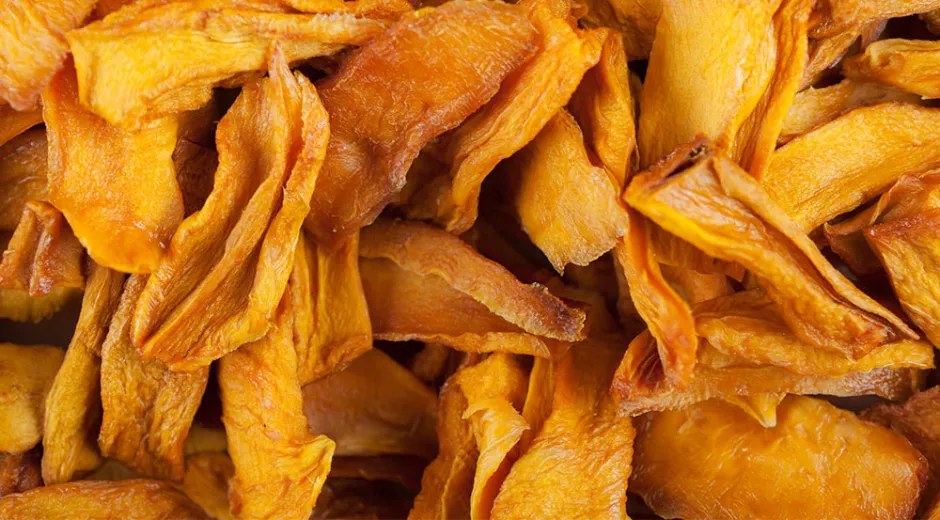
Ghana and Burkina Faso account for the majority of European dried mango supply. Find GFSI-certified wholesale mango suppliers from both origins on Nutrada, filterable by variety, form, and MOQ.
| Field | Detail |
| Botanical name | Mangifera indica |
| Available forms | Slices, strips, diced, powder, freeze-dried |
| Origins | Thailand, Mexico, Philippines, India, Peru, Ghana, Burkina Faso |
| Certifications | GFSI, EU Organic, Fair Trade, Kosher, Halal, Non-GMO |
| Common applications | Snack products, trail mixes, confectionery, smoothie powders, bakery |
| Packaging | 5-25 kg bags |
| MOQ | 25kg |
| Category | Dried Fruits Wholesale |
| Form/Grade | What it means for procurement | Typical application |
| Alphonso slices | Premium variety from India, aromatic, limited volume | High-end snack products |
| Ataulfo slices | Mexican variety, smooth texture, low fibre | Trail mixes, chocolate combinations |
| Tommy Atkins slices | Global commodity grade, fibrous, high volume | Budget snack lines |
| Nam Dok Mai slices | Thai variety, sweet, fibre-free | Premium export products |
| Mango Dices | 5-10mm pieces, various varieties | Bakery applications, cereal toppings |
| Mango powder | Fine ground, max 5% moisture | Smoothie bases, baby food |
| Freeze-dried mango | Minimal moisture, premium processing | High-end confectionery |
Ghana and Burkina Faso are the leading suppliers of natural dried mango to Europe, with established processing operations producing additive-free product suited to ingredient and health food applications.
West African suppliers from these origins also supply certified organic and Fair Trade volumes, which carry a price premium in European health retail and ingredient channels. The Philippines has a long-established dried mango processing sector with export-oriented infrastructure; Cebu province is particularly associated with dried mango production.
Procurement teams co-evaluating dried tropical ingredients alongside dried mango often also assess dried pineapple, as several West African suppliers operate across both product lines.
Dried mango absorbs moisture rapidly above 65% relative humidity, affecting texture and shelf life. Standard packaging uses 5-25kg polyethylene-lined bags with moisture barrier properties. Check the latest CoA for moisture content below 15-20% for slices and confirm SO2 levels if bright orange colour retention is required, as EU regulations require declaration above 10mg/kg. Store below 20°C in dry conditions for 12-18 month shelf life.
Ghana, Burkina Faso, and Mexico hold both EU Organic and USDA NOP certifications for dried mango. West African origins increasingly offer dual Fair Trade and organic certification, though minimum order quantities tend to be higher than conventional supply. Mexican organic suppliers typically process Ataulfo variety with no added sugar, meeting clean-label requirements.
Consumer packaging includes stand-up pouches, resealable bags, and portion-controlled sachets for retail distribution. Private label MOQs start around 500-1000 units with lead times of 6-8 weeks. Fix the added sugar specification before production starts, as conventional dried mango typically contains 15-20% added sugar for palatability enhancement.
Mango processing facilities concentrate in Thailand, Mexico, and the Philippines where fresh fruit supply and export infrastructure align with European quality standards. Request batch-specific certificates of analysis, microbiological reports, and pesticide residue test results to verify tropical origin compliance with EU maximum residue limits. Thai and Philippine suppliers maintain the most comprehensive GFSI certification coverage for European buyers. Nutrada lists GFSI-certified mango suppliers from Thailand, Mexico, and Philippines, covering slices, diced, and powder across conventional and organic supply. All orders are placed directly with certified suppliers, with no intermediary.
Further reading:
Last updated: Apr 6, 2026

Find the right supplier for your food ingredients in under a minute with Nutrada. Nutrada - Sourcing made easy.