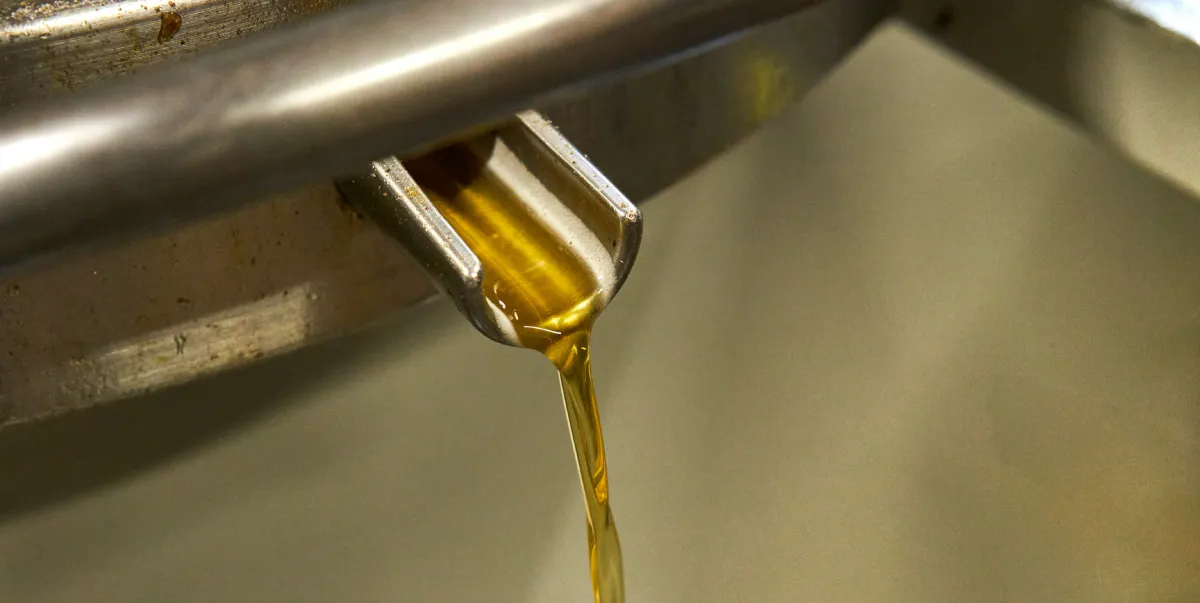
Expeller pressed oil is extracted by a mechanical screw press that generates friction heat up to 99°C. Cold pressed oil uses the same mechanical principle but keeps temperatures below 50°C throughout extraction, as defined by the Codex Alimentarius. For food manufacturers sourcing bulk oils, the difference affects nutrient retention, shelf life, yield, and price per metric ton.
In short:
| Parameter | Expeller Pressed | Cold Pressed |
| Temperature | 60–99°C | Below 50°C |
| Yield | 87–95% | 60–70% |
| Solvents | None | None |
| Price | Baseline | 30–80% premium |
| Nutrient retention | Moderate | High |
| Flavour | Neutral | Characteristic of the seed |
| Typical oils | Sunflower, rapeseed, soy | Olive oil, coconut oil, nut oils |
| Press cake residual oil | 5–13% | 30–40% |
An expeller press is a continuous screw press that feeds oilseeds into a barrel-shaped cavity and applies mechanical pressure to squeeze out the oil. No chemical solvents are used. The friction between the screw, the seeds, and the barrel walls generates heat, typically between 60°C and 99°C, even though no external heat is applied.
The term “expeller” traces back to 1900, when Valerius D. Anderson patented the first continuous mechanical oil extractor under the trademark Expeller®. Today the word is used generically for any screw press extraction, regardless of manufacturer.
Expeller pressing extracts roughly 87–95% of the oil from the seed. The leftover press cake retains 5–13% residual oil and is typically sold as animal feed or further processed with solvent extraction. For food manufacturers buying in bulk, expeller pressed oils offer a good balance between natural-label positioning (“no chemical solvents”) and competitive pricing.
Cold pressing uses the same mechanical screw press principle, but the process is engineered to keep the oil temperature below 50°C at all times. This is the threshold defined by the Codex Alimentarius and referenced in EU marketing standards for virgin oils. Achieving this requires slower press speeds, lower-resistance screw configurations, and sometimes climate-controlled production facilities.
The trade-off is yield. Cold pressing typically extracts only 60–70% of the available oil, which is why cold pressed oils cost significantly more per metric ton. The remaining press cake still contains 30–40% oil and is often expeller pressed separately to recover the rest.
Cold pressing preserves heat-sensitive compounds that matter in premium applications: polyphenols in olive oil, lauric acid stability in coconut oil, and volatile flavour compounds in nut oils. If your end product depends on a specific sensory profile or bioactive content, cold pressed is usually the right specification.
One thing worth flagging from a sourcing perspective: the term “cold pressed” is not consistently enforced outside of olive oil. We’ve reviewed COAs from suppliers marketing rapeseed oil as cold pressed where the peroxide values suggested processing temperatures well above 50°C. The extraction temperature declaration on the technical data sheet is the only reliable check, if a supplier cannot provide one, treat the cold pressing claim with caution.
The extraction method is not just a quality choice, it is dictated by the oilseed itself, the end-market positioning, and in some cases, regulation.
Sunflower and rapeseed oil are overwhelmingly expeller pressed (or solvent extracted) in commercial production. Cold pressed variants exist but represent a small niche, typically organic-certified and sold at premium pricing. If you are sourcing conventional sunflower oil wholesale, you are almost certainly buying expeller pressed and refined product.
Olive oil is the opposite. EU Regulation 29/2012 requires that “extra virgin” and “virgin” classifications be produced exclusively by mechanical means at temperatures that do not alter the oil, effectively mandating cold pressing. Olive pomace oil, by contrast, involves solvent extraction of the remaining oil from the press cake.
Coconut oil splits clearly by grade. Virgin coconut oil (VCO) is cold pressed from fresh coconut meat. RBD (refined, bleached, deodorised) coconut oil is expeller pressed from dried copra and then refined. Both are widely traded in bulk; which one you source depends on whether your formulation requires the coconut flavour profile (VCO) or a neutral, high-heat-stable fat (RBD).
Flaxseed oil is almost always cold pressed for the food market because its high omega-3 fatty acid content (50–60% alpha-linolenic acid) degrades rapidly under heat. Expeller pressed flaxseed oil is typically diverted to industrial or animal feed applications.
Label claims like “cold pressed” or “expeller pressed” are a starting point, but the Certificate of Analysis (COA) tells the real story. Here are the key parameters to verify:
A practical tip: request a pre-shipment sample and run your own peroxide and FFA tests before committing to a new oil supplier. The cost of one lab analysis (€30–80) is negligible compared to rejecting a 20 MT container on arrival. This is especially important for cold pressed oils, where quality degrades faster during transit if temperature control breaks down.
No. Both use mechanical screw presses without solvents, but expeller pressing generates friction heat up to 99°C, while cold pressing is temperature-controlled to stay below 50°C. All cold pressed oils are mechanically pressed, but not all expeller pressed oils qualify as cold pressed.
Lower yield. Cold pressing extracts only 60–70% of the available oil versus 87–95% for expeller pressing. The remaining oil in the press cake is often recovered by expeller pressing separately, adding a processing step. Slower press speeds and climate control further increase production costs.
It depends on the oil. Cold pressed avocado oil has a smoke point around 250°C and handles heat well. Cold pressed flaxseed oil degrades above 107°C and should only be used in cold applications. Always check the smoke point specification on the COA for your intended process temperature.
Historically, olive oil was pressed multiple times using hydraulic presses, and the first pressing produced the best quality. Modern centrifuge extraction is continuous, there is no second press. The term persists for marketing but has no technical meaning in current production. The EU does not regulate the phrase.
Request a COA that includes peroxide value, FFA content, and extraction temperature. Cross-check with sensory evaluation: genuine cold pressed oils have the flavour, colour, and aroma of their source material. Third-party audit reports (IFS, BRC, FSSC 22000) can confirm that the supplier’s facility is equipped for temperature-controlled extraction.
Compare certified oil suppliers across Europe on Nutrada. Filter by extraction method, organic certification, and minimum order quantity to find the right match for your formulation.

Find the right supplier for your food ingredients in under a minute with Nutrada. Nutrada - Sourcing made easy.