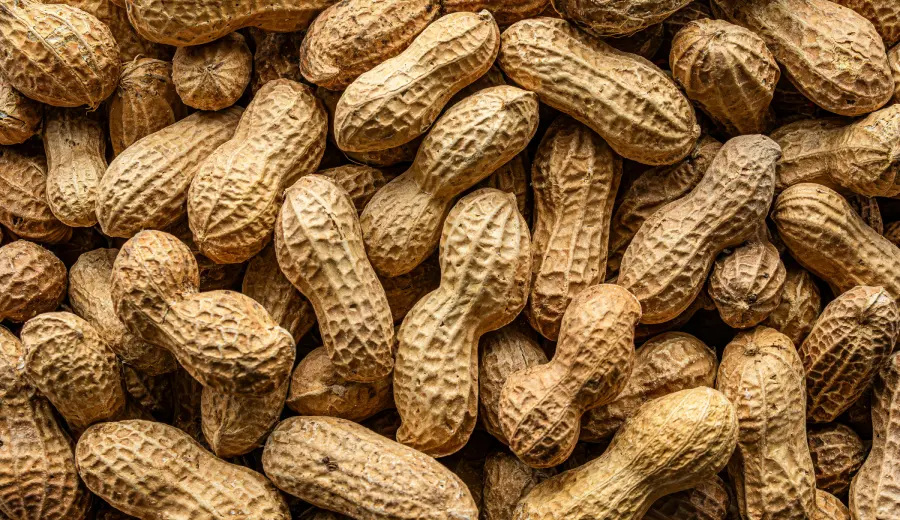
Peanut procurement for EU markets requires aflatoxin testing on every shipment, but not every supplier documents this consistently. Nutrada lists GFSI-certified bulk peanut suppliers from Argentina, the USA, India, and China, filterable by variety, processing form, and quality certification, so you can qualify suppliers on compliance before placing an order.
| Botanical name | Arachis hypogaea |
| Commercial varieties | Runner, Virginia, Spanish, Valencia |
| Available forms | Raw whole, blanched, roasted (dry or oil), chopped, ground, paste, flour, oil |
| Key origins | China, India, USA (Georgia, Texas, Alabama), Argentina, Senegal, Sudan |
| Applications | Peanut butter, confectionery, snack mixes, bakery, sauces, peanut flour, peanut oil |
| Certifications | GFSI (BRC, IFS, FSSC 22000), EU Organic, USDA NOP, allergen-controlled processing |
| Packaging | 10–25 kg vacuum-sealed cartons; 50 kg jute or polypropylene bags |
| MOQ | From 25 kg (varies by form and supplier) |
| Category | Nuts |
Commercial variety selection matters primarily for texture, oil content, and end-use application.
The table below covers the four main commercial varieties:
| Variety | Kernel size | Characteristics | Primary use |
| Runner | Uniform medium | Consistent size for even roasting | Peanut butter (dominant variety) |
| Virginia | Large | Large kernel; premium appearance | In-shell snacking, gourmet roasted peanuts |
| Spanish | Small | Higher oil content; red skin | Confectionery, candy, snack blends |
| Valencia | Small–medium | Naturally sweeter flavour; 3 kernels per pod | Natural peanut butter |
Beyond variety, the processing form determines the final procurement specification. Blanched peanuts (skin removed via hot water or steam) are the standard input for peanut butter and most confectionery applications; skin-on peanuts retain more antioxidants and are preferred for certain roasted snack formats. Roasted peanuts are available dry-roasted (no added oil) or oil-roasted; confirm the roasting profile and oil type if sourcing for flavoured snack applications.
The standard bulk packaging for peanuts are 25 kg vacuum-sealed cartons or 50 kg polypropylene bags; the shelf life is 12 to 18 months when stored cool and dry below 15°C. Peanut oil content (~50%) makes them susceptible to rancidity at elevated temperatures; confirm cold-chain requirements for warm-climate destinations.
Aflatoxin contamination is the primary food safety risk specific to peanuts, and risk increases significantly when post-harvest drying conditions are poor. Peanuts harvested in wet conditions or inadequately dried before storage can develop aflatoxin levels that exceed EU and US limits. Request aflatoxin test results (B1, B2, G1, G2) from an accredited third-party laboratory as a non-negotiable document on every bulk order, not just the Certificate of Analysis from the supplier's own facility.
India is the primary source of certified organic peanuts for European buyers, with EU Organic and India Organic certified supply from established growing regions in Gujarat and Rajasthan.
The USA, primarily from Georgia and Texas, offers USDA NOP certified organic peanuts with strong allergen documentation, typically from dedicated organic processing lines. Organic peanuts carry a 20 to 30% higher price over conventional due to lower yields and stricter certification requirements. For the EU market, request the Certificate of Inspection (COI) for each shipment in addition to the producer's organic certificate, particularly for Indian-origin supply.
Private label peanut products cover dry-roasted and honey-roasted snack formats in 250 g, 500 g, and 1 kg pouches, as well as peanut butter in glass jars from 340 g to 1 kg.
Natural peanut butter (peanuts only, no added stabilizers) has distinct shelf-life characteristics from stabilized formats: oil separation is normal and should be communicated on the label.
Allergen-controlled production lines are essential for any peanut product sold into markets with strict cross-contact disclosure requirements; confirm this is a facility-level capability, not just a production scheduling claim.
China is the dominant global peanut exporter, supplying all major commercial forms including raw, blanched, roasted, and paste, but requires robust third-party aflatoxin documentation for EU import; Chinese-origin peanuts have a persistent RASFF notification history and a supplier's own CoA is not sufficient, an accredited laboratory report is required.
Nutrada lists GFSI-certified peanut suppliers from China, India, the USA, and Argentina, covering raw, blanched, roasted, and processed forms in conventional and organic options.
Last updated: Apr 6, 2026

Find the right supplier for your food ingredients in under a minute with Nutrada. Nutrada - Sourcing made easy.