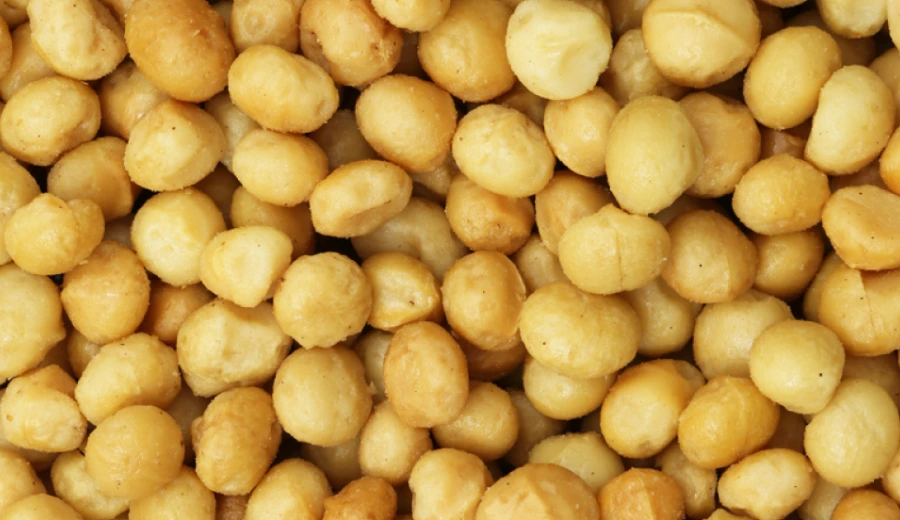
Food manufacturers sourcing macadamia for EU markets require suppliers with specialized cracking equipment and moisture control protocols. Nutrada lists GFSI-certified macadamia suppliers from Australia, South Africa, and Kenya, filterable by kernel style, certification, and MOQ. All macadamia suppliers on Nutrada offer whole kernels, halves, pieces, and powder from integrifolia and hybrid varieties.
| Field | Detail |
| Botanical name | Macadamia integrifolia, M. tetraphylla |
| Available forms | Whole kernels, halves, pieces, diced, powder, paste, flakes, oil |
| Origins | Australia, South Africa, Kenya, Hawaii, Guatemala |
| Certifications | GFSI schemes, EU Organic, USDA NOP, Rainforest Alliance |
| Common applications | Confectionery, premium bakery, ice cream inclusions, nut butter |
| Packaging | Vacuum-sealed bags, nitrogen-flush containers, food-grade drums |
| MOQ | 11.34 kg |
| Category | Nuts Wholesale |
Commercial macadamia trade centers on kernel style grades rather than botanical varieties.
Processing forms include raw whole kernels for roasting operations, diced pieces for cookie inclusions, and powder for flavor applications.
Australia remains the original macadamia homeland with established quality standards and 40,000 MT annual production concentrated in Queensland's subtropical coastal belt. South Africa has emerged as a major EU supplier with rapidly expanding orchards in KwaZulu-Natal and Mpumalanga provinces, offering counter-seasonal harvest timing from March to September. Kenya's high-altitude growing regions produce naturally organic macadamia under minimal-input conditions, with exports growing as processing infrastructure develops. Hawaii maintains premium positioning with 30,000 MT annual production from established orchards, though higher labor costs create significant price premiums over Southern Hemisphere origins.
Macadamia requires critical moisture control below 2% to prevent rancidity development and kernel cracking during storage. Vacuum-sealed packaging or nitrogen-flush containers maintain kernel integrity during transport from origin processing facilities. Buyers must verify kernel recovery rates with suppliers since macadamia shells represent 65-70% of total nut weight, directly impacting final ingredient costs per kilogram of usable kernel.
Kenya holds both EU Organic and USDA NOP certification from naturally low-input farming systems in highland regions. Australia offers certified organic supply from specialized growers in Queensland, though volumes remain limited compared to conventional production. South African organic certification is emerging as estate-level producers transition selected orchards to meet growing EU demand for organic tree nuts.
Retail macadamia packaging includes resealable pouches for whole roasted kernels, glass jars for premium positioning, and portion-control sachets for gift market applications. Private label MOQs typically start at 500kg minimum due to specialized cracking and packaging requirements. Buyers must specify target moisture content before production since macadamia absorbs atmospheric moisture rapidly, affecting shelf stability and crunch texture.
Australian and South African processors concentrate near growing regions due to specialized shell-cracking equipment requirements and kernel fragility during transport. Documentation to request includes batch-specific CoA confirming moisture content, microbiological reports for Salmonella and E.coli, and nutrient profiles showing fat content verification. Nutrada lists GFSI-certified macadamia suppliers from Australia, South Africa, and Kenya, covering whole kernels through powder across conventional and organic supply. All orders are placed directly with certified suppliers, with no intermediary.
Last updated: Apr 6, 2026

Find the right supplier for your food ingredients in under a minute with Nutrada. Nutrada - Sourcing made easy.