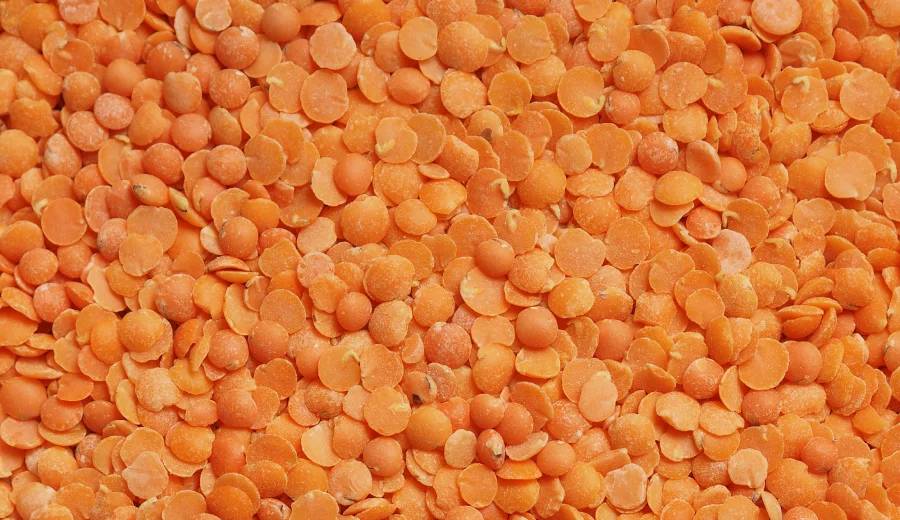
Nutrada lists GFSI-certified red lentil suppliers from Canada, Turkey, and India covering split, whole, and flour forms, filterable by pesticide residue documentation, organic certification, and moisture specification.
| Botanical name | Lens culinaris |
| Available forms | Split red lentils (skin removed), whole red lentils (football lentils), red lentil flour |
| Key origins | Canada, India, Turkey, Australia |
| Applications | Soups, dal, purees, ready meals, gluten-free flour blends, pasta, plant-based protein products |
| Certifications | GFSI (BRC, IFS, FSSC 22000), EU Organic, USDA NOP, non-GMO |
| Packaging | 25 kg or 50 kg polypropylene bags; 1,000 kg big bags |
| MOQ | From 25 kg (varies by form and supplier) |
| Category | Lentils |
Split red lentils are the default procurement form for soup manufacturing and ready meal applications; the skin-removal step reduces cook time and produces the smooth, creamy texture required in most industrial formulations.
Whole red lentils (also called football lentils, for their rounded shape with skin intact) are a distinct procurement category with longer cook times and better shape retention under heat.
Red lentil flour is a separate specification relevant to gluten-free pasta and flatbread applications, with its own protein percentage and particle size requirements.
| Form | Key characteristic | Primary application |
| Split red lentils | Skin removed; cooks to a soft, creamy texture in 15–20 min without soaking | Soups, dal, purees, ready meals, baby food |
| Whole red lentils (football lentils) | Skin intact; longer cook time; holds shape better than split | Canned goods, whole-grain retail formats, salads |
| Red lentil flour | Finely milled from split lentils; high protein (25–28%), gluten-free | Gluten-free pasta, flatbreads, protein-enriched bakery |
| Red lentil protein | Protein concentrate or isolate extracted from red lentils; typically 60–90% protein content. | Used in plant-based food formulations and sports nutrition. |
The Codex Standard for Lentils (CXS 114-1981) defines maximum moisture, foreign matter, and defect tolerances applicable to whole and split forms.
Moisture control at intake is the critical storage variable: above 14%, mycotoxin and insect infestation risk increases during storage regardless of packaging format. Standard packaging is 25 to 50 kg polypropylene bags, with 1,000 kg big bags available for high-volume manufacturing. A 20-foot container holds approximately 22 to 24 MT of bagged split red lentils. Request the following on the Certificate of Analysis:
Canada harvests from August to October, with new crop entering the market from October. Canada exported approximately 1.99 million metric tons of red lentils in 2023, making it the dominant global supplier; pricing is strongly influenced by Saskatchewan harvest conditions.
Canada is the main source of certified organic red lentils for European buyers, with EU Organic and USDA NOP certified supply from Saskatchewan-based producers. Turkey supplies organic red lentils under EU Organic certification and is a cost-competitive alternative for buyers in Southern and Eastern Europe. Request both the producer's annual organic certificate and the Certificate of Inspection for each shipment for EU imports.
Split red lentils in 400 g, 500 g, and 1 kg retail pouches are the standard private label format for the dried-goods aisle. Packaging materials must provide a moisture barrier to maintain quality over a 24-month shelf life. Red lentil flour in retail-sized bags is a growing private label format for the gluten-free bakery segment; confirm particle size specification with your supplier, as coarse and fine grinds behave differently in pasta and flatbread formulations.
Canada, primarily Saskatchewan and Alberta, is the benchmark origin for European food manufacturers in terms of food safety documentation, consistent sizing, and pesticide compliance. Turkey is an important regional origin with shorter lead times than Canada and competitive pricing for conventional split red lentils. India-origin supply is available but requires more rigorous supplier qualification for EU food safety compliance, including verification of the inspection body's recognition under the EU organic import framework for certified organic supply.
Nutrada lists GFSI-certified red lentil suppliers from Canada, Turkey, and India, covering split, whole, and flour forms in conventional and organic-certified options.
Last updated: Apr 17, 2026

Find the right supplier for your food ingredients in under a minute with Nutrada. Nutrada - Sourcing made easy.