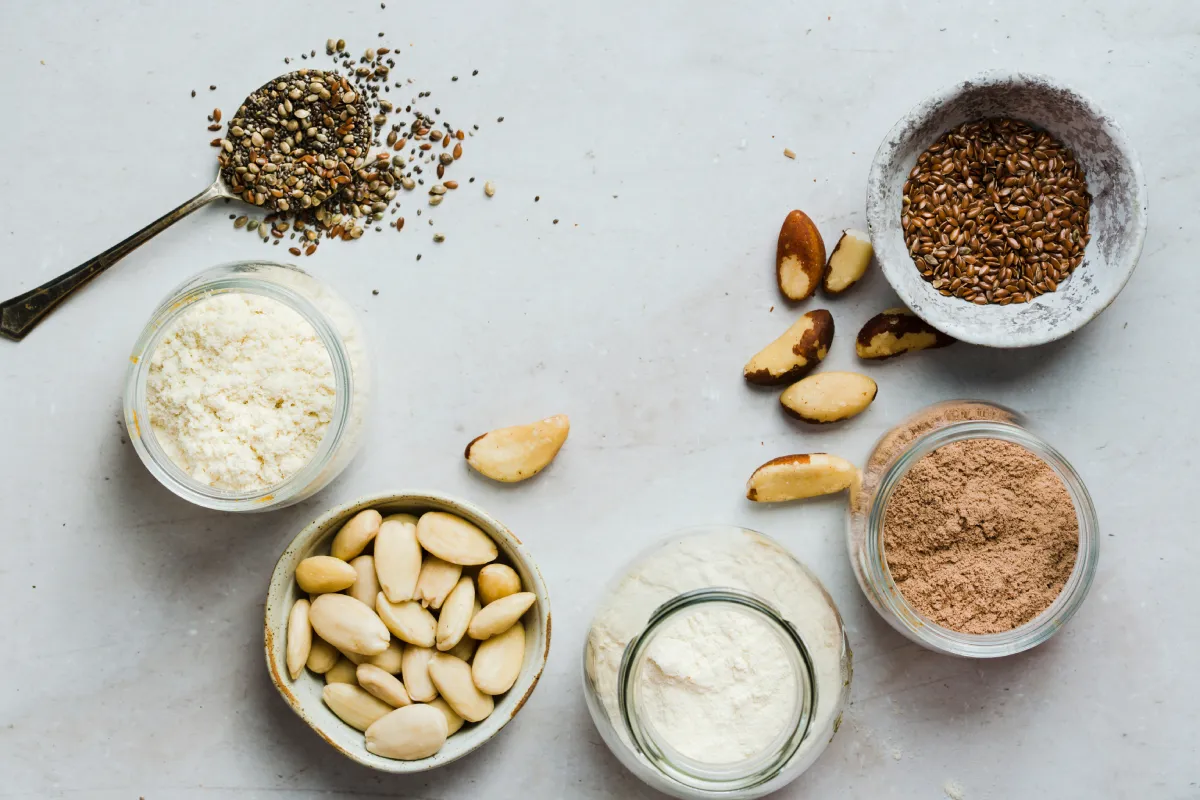
Flaxseed and chia seed are the two dominant plant-based omega-3 sources in food manufacturing. Both are high in ALA (alpha-linolenic acid), both carry soluble and insoluble fibre, and both form a gel when hydrated. For procurement, the differences that matter are origin supply chains, shelf-life behaviour, EU regulatory status, and application fit. Nutrada lists GFSI-certified flaxseed and chia seed suppliers across North America, South America, and Europe, searchable by certification, format, and minimum order quantity.
In short:
Both are small oilseeds consumed whole or ground, but they come from unrelated plants. Flax (Linum usitatissimum) is an annual herb from the Linaceae family, cultivated for centuries for both seed and fibre. Chia (Salvia hispanica) is from the mint family (Lamiaceae) and native to Mexico and Guatemala.
At specification level, the two seeds sit close but are not identical:
| Parameter | Flaxseed | Chia seed |
| Scientific name | Linum usitatissimum | Salvia hispanica |
| Oil content | 42-45% | 28-32% |
| ALA (% of oil) | 50-59% | 50-57% |
| Protein | 20-25% | 16-20% |
| Fibre | 28% | 34-42% |
| Water absorption | ~4x weight (ground) | ~10-12x weight (whole) |
| Seed size | 4-7 mm | 1-2 mm |
| Colour variants | Brown, golden | Black, white |
Flax and chia have fundamentally different supply geographies. Flax is a mature commodity with a broad global supply; chia is concentrated in a narrow band of South American producers.
Canada produces approximately 40% of the flax supply in the world and is the largest global exporter. Within Canada, Saskatchewan accounts for the majority of production. Other significant origins include Russia, Kazakhstan, China, the United States (mainly North Dakota), and within the EU, Germany, the UK, and France.
For European buyers, Canadian brown flax is the benchmark for conventional supply. Kazakhstan has grown into a meaningful alternative origin, particularly for price-sensitive buyers and for supply during Canadian shortfalls. Golden (yellow) flax, known commercially as solin or Linola, is cultivated at smaller volumes than brown and carries a modest premium for bakery applications where a paler colour is preferred.
South America dominates global chia production. Paraguay is the largest producer, with approximately 49,000 metric tons in 2023 according to the Paraguayan Chamber of Sesame Exporters. Bolivia is second at around 12,000 tons annually, followed by Argentina and smaller volumes from Peru, Mexico, and Ecuador. Australia has an established export supply into regulated markets, but at much smaller scale.
The narrow producer base creates volatility. Chia farm-gate prices have fluctuated by roughly 30% year-over-year in recent seasons, driven by South American weather (drought conditions in 2024 cut Bolivian output by half) and by the thin futures market, fewer than 20 active traders set price discovery. For procurement, this means forward contracting and origin diversification matter more for chia than for flax. Buyers sourcing chia seeds from a single origin are exposed to full crop risk; those who can take Paraguay and Bolivia supply are better positioned.
This is the single biggest procurement difference between the two seeds in the European market, and one that recipe-focused comparison articles ignore entirely.
Flaxseeds have been consumed in the EU for thousands of years, and it is treated as a conventional ingredient with no specific authorisation required beyond standard food safety law.
Chia seed is a novel food under Regulation (EU) 2015/2283. It was first authorised in bread in 2009 at a maximum 5% inclusion, with authorisation gradually extended: to 10% in baked goods, breakfast cereals, and fruit/nut/seed mixes, and later to juices, yoghurt, fruit spreads, and ready-to-eat meals. A 15 g/day consumer intake warning was required on pre-packaged chia until Commission Implementing Regulation (EU) 2020/24 removed the maximum use levels and the labelling requirement based on the 2019 EFSA safety reassessment.
What this means for formulation: if you are launching a product in the EU that contains chia, check the current Union list of novel foods for the specific category and inclusion limits that apply. A product launched a few years ago may now be compliant at higher inclusion rates than when it was formulated, which can be a reformulation opportunity. For flax, the process is simply standard food safety compliance with no novel food dossier involved.
This is the most important functional difference for manufacturers. ALA is an unsaturated fatty acid susceptible to oxidation, which produces rancidity and off-flavour. The two seeds manage this very differently.
Whole flaxseeds are remarkably stable. The hard seed coat protects the oil from oxygen and light exposure, and studies from industry laboratories have shown no measurable oxidation of whole flax after 280-308 days at ambient room temperature (22°C). Once ground, however, the picture changes fast. Home-ground flax oxidises within 7-10 days at room temperature.
Industrial milled flax is different from home-ground. Commercial cold-milled flax packed in triple-layer paper bags with plastic liners has been shown stable for at least 128 days at 23°C without measurable oxidation. Under warehouse conditions in sealed, air-excluded packaging, milled flax can carry a 9-20 month shelf life. This is why the packaging format and the mill-to-delivery time matter more for ground flax than for most other ingredients.
Chia seed has a natural mucilage coating and denser structure that gives it inherent oxidative resistance. Whole chia is typically rated for 2 years shelf life at ambient; ground chia holds 12-18 months in sealed packaging. The practical consequence is that chia works in applications where flax does not: bulk ground chia inclusion in cereal or bar mixes, export to warm-climate markets, and products with long retail shelf expectations.
For buyers sourcing flaxseeds for ground applications, request the mill date, the packaging specification (paper with PE liner, vacuum, or nitrogen-flushed), and a current peroxide value on the certificate of analysis. These three data points predict how much usable shelf life you have once you receive the material.
The gel-forming and ALA-carrying properties overlap, but the functional behaviour differs enough that the two are not always interchangeable.
Whole flax passes through the digestive tract largely undigested. The hard seed coat is not broken down by human digestion, which means the omega-3 content is not bioavailable unless the seed is ground. This has pushed most formulations using flax for health positioning toward ground or milled formats, despite the shelf-life trade-off.
Chia does not have this problem. The mucilage coating interacts with digestive fluids and releases the omega-3 content, whether the seed is whole or ground. This gives formulators more flexibility: whole chia delivers visible texture in yoghurts and beverages; ground chia is used where neutrality is needed.
For procurement planning:
Five specifications drive procurement outcomes for both seeds:
| Factor | Flaxseed | Chia seed |
| Main origins | Canada (40% of the world), Kazakhstan, Russia, EU (Germany, UK, France) | Paraguay (largest), Bolivia, Argentina, Australia |
| Typical MOQ | 1-25 tonnes | 1-25 tonnes (often 5 tonnes minimum from SA origins) |
| Packaging | 25 kg paper with PE liner; 1-tonne big bags; nitrogen-flushed for ground | 25 kg PP bags; vacuum packing for ground; 1-tonne bulk bags |
| Lead time from origin | 4-6 weeks Canada to EU; 3-5 weeks Kazakhstan | 6-10 weeks from South America (transit often 60+ days) |
| Price volatility | Moderate (follows oilseed complex) | High (thin market, weather-sensitive) |
| Organic availability | Well-established (Canada, Kazakhstan organic programmes) | Established (Paraguay, Bolivia); 15-20% premium typical |
| EU regulatory status | Conventional ingredient, no novel food status | Novel food under Regulation (EU) 2015/2283 with specific use categories |
| Whole shelf life | Up to 36 months ambient | Up to 24 months ambient |
| Ground shelf life (sealed) | 9-20 months | 12-18 months |
For buyers sourcing across multiple seed categories, consolidating shipments within grains can reduce per-unit logistics cost. Flaxseed also crosses into the oils category as flaxseed oil for formulators preferring a pre-pressed input over whole-seed grinding.
Not reliably. ALA content per gram is broadly comparable, but water absorption is very different, chia absorbs roughly 10-12 times its weight in liquid whole, flax absorbs around 4 times its weight ground. This means substituting 1:1 in a gel, pudding, or egg-replacement application will change the hydration behaviour significantly. For pure nutritional claims (ALA, fibre), a 1:1 swap is workable with testing. For functional applications, expect reformulation.
Golden (yellow) flax is cultivated at smaller volumes than brown, which creates a supply-side premium. Nutritionally, the two varieties are comparable. The commercial case for golden flax is mainly visual and flavour-driven: it produces a lighter colour and milder flavour in baked goods and smoothies. Most buyers sourcing for white-bread bakery or pale-colour cereal applications prefer golden; cost-driven formulations typically use brown.
Yes, but with different characteristics. Canadian and Kazakh organic flax supply is well-established and relatively stable year-over-year. Organic chia from Paraguay and Bolivia is available but subject to greater supply variability. Organic chia prices in 2024-2025 rose notably during the South American drought years. Organic chia typically commands a 15-20% premium over conventional; organic flax premium is typically similar or slightly lower.
Chia from Paraguay has faced repeated EU border scrutiny for pesticide residues, particularly glyphosate and chlorpyrifos. This has pushed some Paraguayan exporters to tighten field-level controls, but buyers should request batch-level pesticide test results for EU-bound shipments. Flax has fewer flagged residue issues, but chlormequat (used as a plant growth regulator) has appeared in European monitoring data. In both cases, ask for the full pesticide multi-residue analysis, not just a compliance statement.
For EU food manufacturing, GFSI-benchmarked certification is the baseline: BRC, IFS, FSSC 22000, or SQF. Organic claims require EU Organic (Regulation 2018/848) or USDA Organic for the US market. Kosher and Halal are straightforward for both flax and chia. For chia specifically, verify that the supplier has current novel food compliance documentation for the specific EU use categories your product falls under.
Further Reading:


Find the right supplier for your food ingredients in under a minute with Nutrada. Nutrada - Sourcing made easy.