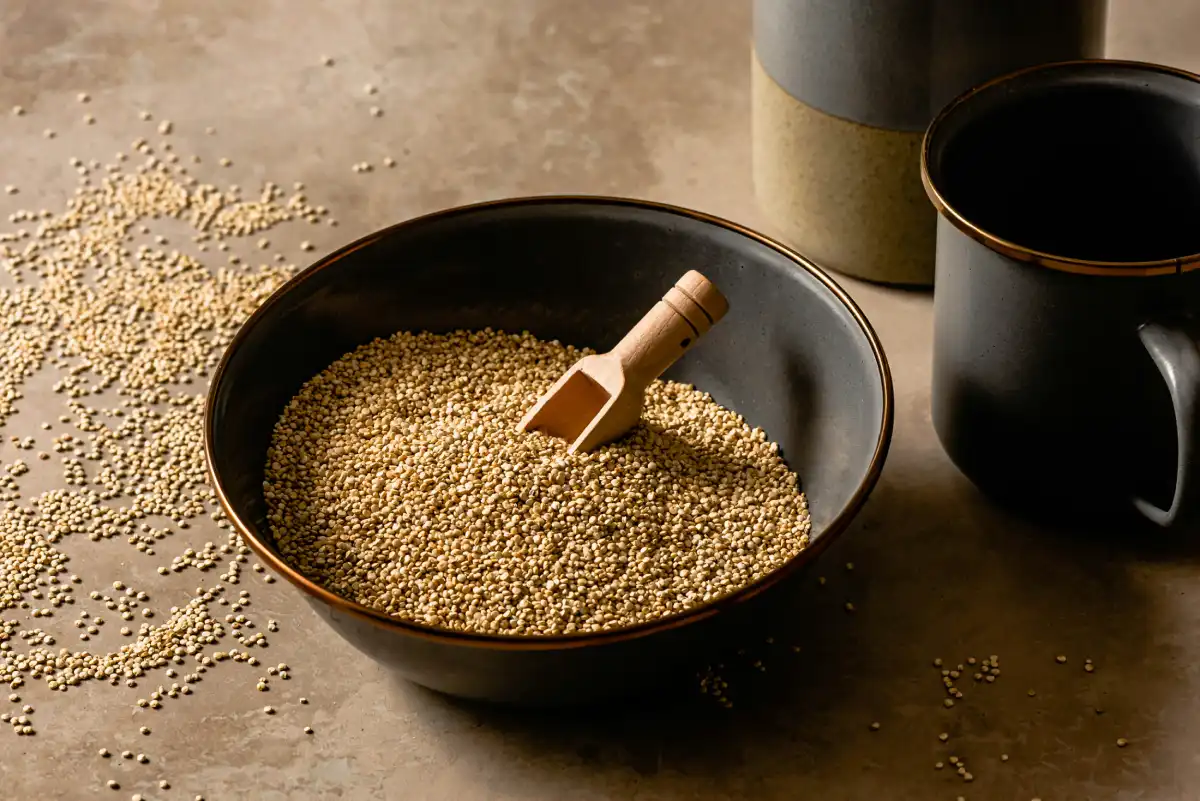
Amaranth and quinoa are both pseudocereals, meaning they are seeds that function like grains in cooking and food manufacturing but do not belong to the grass family. Both are naturally gluten-free, high in protein, and contain all nine essential amino acids. However, they differ significantly in origin, processing, texture, pricing, and manufacturing applications. Nutrada lists GFSI-certified amaranth and quinoa suppliers from South America, India, and Mexico, searchable by certification, form, and order volume.
In short:
Both pseudocereals have nutritional profiles that outperform common cereals like wheat and rice, particularly in protein quality. Peer-reviewed research published in Food Chemistry confirms that both amaranth and quinoa contain higher proportions of essential amino acids than wheat, rice, or corn. The lysine content in pseudocereals is roughly double that of wheat on average, which is significant for manufacturers making protein-enrichment or "complete protein" claims.
| Nutrient (per 100g dry) | Amaranth | Quinoa |
| Protein | 14-18 g | 12-16 g |
| Fat | 6-9 g | 5-7 g |
| Carbohydrates | 58-66 g | 64-74 g |
| Dietary fiber | 8-16 g | 7-15 g |
| Lysine | High (comparable to soybean) | High (2.4-7.8 g/100g protein) |
| Calcium | 159 mg (significantly higher) | 47 mg |
| Iron | 7-8 mg | 4-5 mg |
| Magnesium | 248 mg | 197 mg |
| Calories | ~370-410 kcal | ~360-370 kcal |
| Gluten | None | None |
Amaranth stands out for its mineral density. It contains roughly three times more calcium and nearly twice the iron of quinoa per 100g serving. This makes amaranth a stronger ingredient choice for products targeting bone health, iron fortification, or mineral-enrichment claims. Quinoa, in contrast, has a milder nutritional profile but is more widely recognised by consumers, which matters for product labelling and marketing.
Both crops originated in the Americas and were staple foods for pre-Columbian civilisations, but their modern supply chains look very different.
Quinoa was domesticated near Lake Titicaca in the Peruvian and Bolivian Andes roughly 5,000 years ago. Today, Peru and Bolivia account for over 99% of EU quinoa imports. Peru dominates the conventional quinoa supply with higher yields from irrigated coastal regions. Bolivia is the primary source of organic and Royal quinoa, grown at extreme altitudes above 3,600 metres. Quinoa production has also expanded to Europe (France, Spain, the Netherlands) and the US, though South American origins still dominate trade volumes.
Amaranth has a more dispersed origin pattern. Three separate species were domesticated independently: Amaranthus cruentus and A. hypochondriacus in Mexico and Central America, and A. caudatus in the South American Andes. Today, India is the largest producer of amaranth globally, followed by China, Mexico, Nigeria (primarily for leaf production), and Peru/Bolivia. Germany is the principal consumer market for amaranth seeds in Europe. The fragmented supply chain means amaranth buyers need to evaluate more origin options than quinoa buyers, but it also means less dependence on a single region.
The most important practical difference between amaranth and quinoa for food manufacturers is texture after cooking. Quinoa cooks into distinct, fluffy grains with a visible "tail" (the germ separating from the seed). This makes quinoa a direct substitute for rice, couscous, or bulgur in ready meals, grain bowls, and salads.
Amaranth, by contrast, becomes gelatinous and sticky when boiled. This porridge-like consistency makes it unsuitable as a rice alternative but excellent as a porridge base, a thickening agent for soups and sauces, or a binding ingredient in cereal bars and energy balls. Amaranth can also be popped (heated rapidly in a dry pan or popping machine), producing tiny, crunchy puffed grains that are the traditional preparation in Mexico (alegrías) and increasingly used in European cereal and snack bar manufacturing.
For flour applications, both grains are milled into gluten-free flours. Amaranth flour has a stronger, slightly peppery flavour and works best when blended with milder flours (rice, tapioca) at 15-25% of the total flour weight. Quinoa flour has a milder, nuttier taste and can be used at higher inclusion rates. Neither flour contains gluten, so both require binding agents (xanthan gum, psyllium, eggs) in baking applications.
Amaranth is generally less expensive than quinoa in the EU market. The price gap reflects quinoa's stronger consumer recognition, more established premium positioning (especially Bolivian Royal quinoa), and the overall demand imbalance that has kept quinoa prices elevated since the crop's international popularisation in the early 2010s.
Amaranth pricing is more volatile because the supply chain is less mature. Indian-origin amaranth is typically the most competitively priced, while Mexican and Peruvian organic amaranth commands a premium. The popped (puffed) format is priced higher than whole grain due to the additional processing step. For manufacturers looking to add a high-protein, gluten-free ingredient at a lower cost than quinoa, amaranth is worth evaluating.
Organic certification affects pricing for both crops. The transition to EU Regulation 2018/848 (compliance regime replacing equivalence as of January 2025) has increased certification costs for smallholder producer groups in Bolivia, Peru, and India, and these costs are being passed through to buyers. Sourcing across the broader grains category allows buyers to compare pricing across both pseudocereals and identify the best value for their specific formulation needs.
| Application | Better choice | Why |
| Rice/grain substitute in ready meals | Quinoa | Distinct grain texture, fluffy when cooked, consumer recognition |
| Porridge and breakfast cereals | Amaranth | Gelatinous cooking texture, higher mineral content |
| Cereal bars and energy snacks | Amaranth (popped) | Puffed amaranth provides crunch without large grain size |
| Gluten-free flour blends | Both (combined) | Complementary flavour profiles and amino acid coverage |
| Protein-enriched products | Amaranth | Higher protein (14-18%), stronger lysine, lower cost per gram of protein |
| Baby food and infant cereals | Quinoa | Milder flavour, established safety profile, consumer familiarity |
| Salads and cold grain bowls | Quinoa (red variety) | Holds shape after cooking and cooling; visually appealing |
| Soup thickening | Amaranth | Natural gelatinous texture when cooked in liquid |
| Visual premium (retail) | Quinoa | Stronger brand recognition, tricolor option available |
Many manufacturers use both pseudocereals in different product lines or blend them within a single formulation. An amaranth-quinoa flour blend captures the higher protein and mineral content of amaranth while benefiting from quinoa's milder flavour and consumer familiarity. This blended approach is increasingly common in European gluten-free bakery and cereal products.
Both amaranth and quinoa are inherently gluten-free. Neither belongs to the Poaceae (grass) family, and neither contains the prolamin proteins that trigger celiac disease. Research published in the American Journal of Gastroenterology has confirmed quinoa's safety for celiac patients, and amaranth flour has been shown to have near-zero prolamin content.
The risk for food manufacturers is cross-contamination, not the ingredients themselves. If amaranth or quinoa is processed, stored, or transported using equipment also used for wheat, barley, or rye, gluten contamination can occur. For gluten-free product claims in the EU (below 20 ppm gluten per Regulation (EU) No 828/2014), buyers should specify segregated handling in their supply chain and request gluten testing on the COA.
Both amaranth suppliers and quinoa suppliers on Nutrada include certification details (BRC, IFS, FSSC 22000, organic) in their profiles, allowing buyers to filter specifically for gluten-free handling capabilities.
The choice between amaranth and quinoa is not a nutritional contest. It is a formulation decision that depends on the product being developed, the target consumer, the price point, and the required functionality.
Both are highly nutritious pseudocereals with complete protein profiles. Amaranth has higher calcium (roughly three times more), iron, and slightly more protein per 100g. Quinoa has a lower glycemic index (53 vs amaranth's 97) and is better suited for blood sugar management applications. Neither is categorically "healthier"; the better choice depends on the specific nutritional claims and formulation goals of the product being developed.
Not directly in most cases. Cooked amaranth has a gelatinous, porridge-like texture, while quinoa produces distinct fluffy grains. Amaranth works as a quinoa replacement in porridges, soups, and baked goods where texture is less critical. For salads, grain bowls, and rice-substitute applications, quinoa is the correct ingredient. In flour form, the two are more interchangeable.
Popped amaranth tastes similar to miniature popcorn with a mild, nutty flavour. The popped grains are tiny (roughly 1mm diameter after popping) and crunchy. In Mexico, popped amaranth mixed with honey or sugar syrup is a traditional confection called alegría. In food manufacturing, popped amaranth is used as a crunchy inclusion in cereal, granola bars, chocolate coatings, and yoghurt toppings.
Both amaranth and quinoa contain saponins, which are bitter-tasting compounds that should be removed before consumption. Quinoa saponin is well-understood and commercially removed through washing and polishing. Amaranth also contains saponins, though at lower levels, and cooking substantially reduces them. Oxalic acid is present in both crops (and in the leaves and stems of both plants), which can inhibit mineral absorption. Standard cooking processes reduce oxalate levels to safe ranges.
Peruvian and Bolivian exporters sometimes offer both crops, since amaranth (A. caudatus) grows in the same Andean regions as quinoa. Indian exporters are strong on amaranth but do not typically supply quinoa. Nutrada allows buyers to search for suppliers offering both products, compare certifications, and request samples from multiple origins within a single platform.
Further reading:


Find the right supplier for your food ingredients in under a minute with Nutrada. Nutrada - Sourcing made easy.