Agave syrup and maple syrup are both liquid natural sweeteners, but they occupy very different procurement profiles. Agave is a high-fructose Mexican-origin product with a low glycemic index. Maple syrup is a regulated sucrose-based syrup from Canada and the northern United States, sold under a harmonised four-grade system. Nutrada lists GFSI-certified agave and maple syrup suppliers across Mexico, Canada, and the United States, searchable by certification and minimum order quantity.
In short:
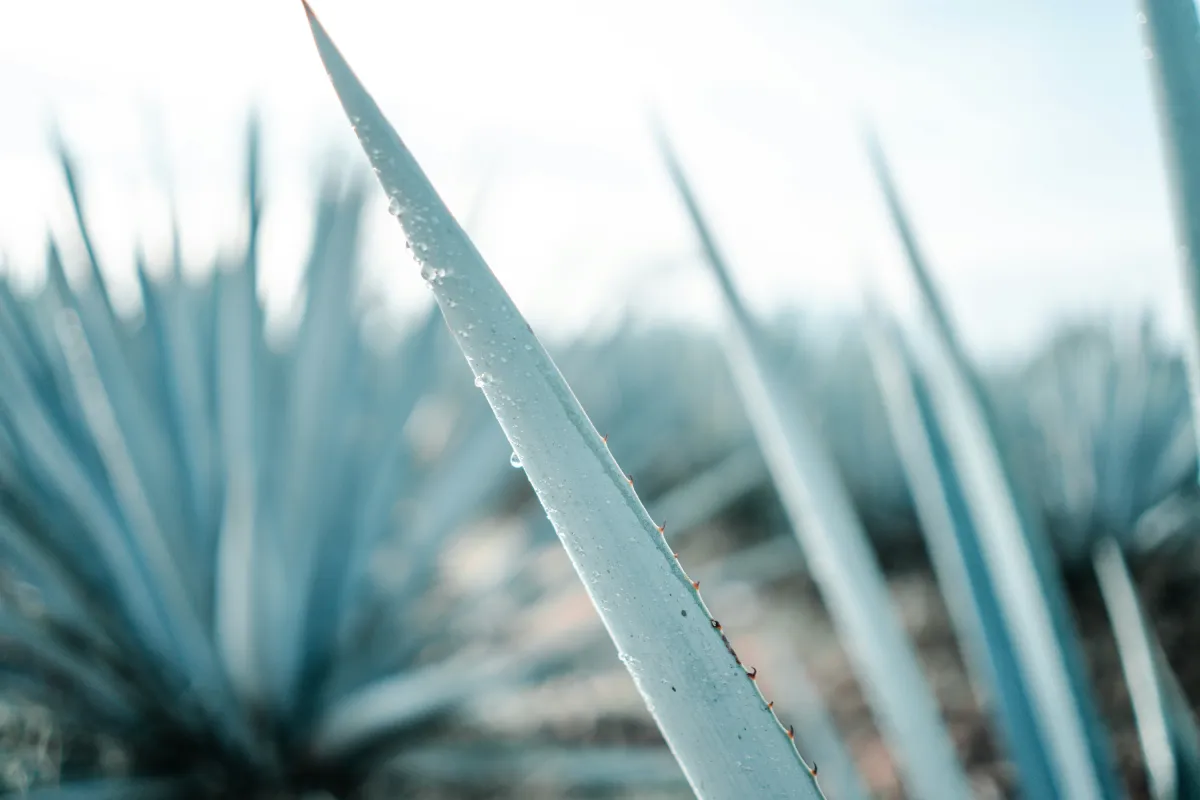
Agave syrup, also called agave nectar, is produced from the sap of cultivated agave plants. The two main commercial species are Agave tequilana (blue agave) and Agave salmiana, both grown in Mexico. The plant stores carbohydrates as fructans, which are long-chain fructose polymers, in its core or piña. Producers harvest the piña, extract and hydrolyse the fructans thermally or enzymatically into simple sugars, filter the liquid, and concentrate it to a honey-like consistency.
The finished product is typically 74-76 percent soluble solids and 23-25 percent water, with negligible protein and fat. Sugar composition varies by species and processing. Blue agave syrup is approximately 56 percent fructose and 20 percent glucose. Salmiana-based syrup can reach 80-90 percent fructose when hydrolysis is more complete. This high fructose share is what gives agave syrup its low glycemic index of 10-27, which compares to roughly 65 for sucrose and 54 for honey.
Agave is sold in light, amber, dark, and raw grades. Light has a nearly neutral flavour and is used in sports drinks, yogurts, and kombucha where the sweetener should not contribute colour or taste. Amber and dark carry caramel notes from browning reactions during concentration, and are used in baked goods, barbecue sauces, and flavoured dairy. Raw agave is minimally processed and retains more of the original plant character.
Maple syrup is the concentrated sap of the sugar maple (Acer saccharum), red maple (Acer rubrum), or black maple (Acer nigrum). Producers tap trees in late winter and early spring, collect sap (typically 2-3 percent sugar), and boil it in evaporators to concentrate it. Roughly 40 litres of sap yield one litre of syrup.
The US FDA defines maple syrup under 21 CFR 168.140 as having a minimum solids content of 66 degrees Brix. The USDA Agricultural Marketing Service grading standards cap Grade A syrup at 68.9 degrees Brix to prevent crystallisation during storage. Anything below 66 percent sugar can spoil; anything above 67 percent starts forming crystals at the bottom of the container.
Sucrose is the dominant sugar, typically 98 percent or more of the carbohydrate content in fresh syrup. During storage, some sucrose hydrolyses into glucose and fructose, particularly in darker grades. The reported glycemic index of maple syrup is approximately 54.
Since 2015, the US and Canada have harmonised their grading into four Grade A classes based on light transmittance measured against a reference standard: Golden (greater than 75 percent transmittance), Amber (50.0-74.9 percent), Dark (25.0-49.9 percent), and Very Dark (less than 25 percent). Golden is produced early in the harvest when sap is cleanest. Very Dark is end-of-season syrup with the most intense caramelised flavour and is often the grade of choice for food manufacturing, because the flavour carries through baking, roasting, and fermentation. A fifth classification, Processing Grade, covers syrup that meets solids content and basic quality criteria but fails colour uniformity or flavour requirements. Processing Grade must be packed in containers of 5 gallons or larger and cannot be sold in consumer-size retail packs, but it is commonly used as a food manufacturing ingredient.
| Specification | Agave Syrup | Maple Syrup |
| Source species | Agave tequilana, Agave salmiana | Acer saccharum, Acer rubrum, Acer nigrum |
| Main origins | Mexico (Jalisco, Guanajuato, San Luis Potosí) | Canada (Quebec), United States (Vermont, New York, Maine) |
| Typical Brix | 74-76 percent | 66-68.9 percent (Grade A statutory range) |
| Dominant sugar | Fructose (56-90 percent depending on species) | Sucrose (98 percent or more fresh; partial hydrolysis over time) |
| Glycemic index | 10-27 | approximately 54 |
| Grading system | Light, Amber, Dark, Raw (no statutory grading body) | USDA/IMSI harmonised: Golden, Amber, Dark, Very Dark, plus Processing Grade |
| Price tier (conventional) | Commodity-level | Premium |
| Shelf life (unopened) | 24 months ambient | 24 months ambient |
| Storage after opening | Ambient acceptable | Refrigeration required |
| Organic availability | USDA NOP, EU Organic widely available | USDA NOP, EU Organic, Canada Organic widely available |
| Kosher / Halal | Routinely certified | Routinely certified |
Agave syrup is produced almost exclusively in Mexico. Jalisco is the traditional centre of blue agave cultivation. Salmiana-based syrup production is concentrated in San Luis Potosí and Guanajuato. The global agave nectar market is projected to reach 455 billion USD by 2036.
Maple syrup production is geographically concentrated in northeastern North America because the species and the specific freeze-thaw temperature cycle needed for sap flow only occur there. Agriculture and Agri-Food Canada reported that Canadian producers harvested 119.5 million kilograms of maple syrup in 2024, representing approximately 73 percent of global output. Quebec alone accounted for 108.4 million kilograms, or 90.7 percent of Canadian production. The United States produced approximately 23 percent of global supply in 2024, with Vermont accounting for 53 percent of US output, New York 14.4 percent, and Maine 12 percent. The Global Strategic Maple Syrup Reserve, held by Quebec's QMSP producer federation, acts as a buffer against weather-driven yield volatility and allows buyers to secure consistent supply even after a poor harvest year.
This geographic concentration is itself a procurement consideration. A single weather event in Quebec can move global maple prices within weeks. Agave supply is less weather-sensitive but has its own constraints. Mature blue agave takes 7-14 years to reach harvest readiness, and supply cycles tied to tequila demand periodically push nectar prices up when agave distillers outbid syrup producers for piñas.
In beverages, agave is the default for smoothies, sports drinks, kombucha, and any formulation that needs clear dissolution in cold liquid without contributing flavour. Its 1.4 to 1.6 times sweetness relative to sucrose also lets manufacturers reduce total sugar declarations on the nutrition panel while matching sweetness targets. Maple syrup is used in flavoured coffee drinks, craft beer brewing, and functional beverages where the maple flavour itself is the selling point.
In bakery, maple appears in glazes, granolas, and speciality breads where the flavour notes need to survive baking temperatures. Grade A Dark and Very Dark are the commercial choices here. Lighter grades lose flavour definition in high-heat applications. Agave is used in vegan bakery formulations as a honey substitute and in bars or protein products where a low-GI positioning is part of the marketing claim.
In sauces and marinades, the caramel profile of darker maple grades makes it the standard for barbecue rubs, maple-cured bacon, and glazes for pork and salmon. Agave is common in vegan teriyaki, Asian-style hot sauces, and smoothie bases where a neutral sweetness is required.
For clean-label positioning, both have appeal but for different reasons. Maple syrup is a single-ingredient natural product with centuries of consumer recognition. It carries no manufacturing process controversy. Agave's story is more contested. The hydrolysis step in some commercial production resembles industrial processing more than natural extraction, which matters for brands that want to back up clean-label claims under scrutiny. Review the supplier's process flow before committing to such claims.
For EU market access, any agave or maple supplier should hold a GFSI-benchmarked food safety certification: BRCGS, IFS, FSSC 22000, or SQF. This is the baseline, not a premium feature. Without it, most private-label buyers and the major European retailers will not engage.
Organic certification is widely available for both products. Maple syrup from Vermont and Quebec is commonly certified under Canada Organic, USDA NOP, or EU Organic under Regulation (EU) 2018/848. Organic premiums on maple run approximately 10-20 percent above conventional prices, according to 2024 industry outlook data. Agave is certified under similar frameworks. Mexican producers typically hold both USDA NOP and EU Organic dual certification for export flexibility.
Kosher certification (OU, Kof-K, OK) and Halal certification are both routinely available. Both products are naturally vegan, which satisfies a common formulation requirement for brands positioning against honey.
One certification category worth understanding is origin labelling. Only syrup produced in Canada from Canadian sap can be labelled Product of Canada under Canadian Food Inspection Agency rules. US producers label at the state level (Vermont Maple, for example). Buyers selling into premium markets often want the origin-specific label rather than generic North American maple, because consumers associate Quebec and Vermont specifically with quality.
Agave syrup trades at commodity-like prices relative to other natural sweeteners. Indicative conventional bulk wholesale pricing (totes/drums, delivered) typically sits in the low-to-mid teens USD per kg, with organic at a 20–30 percent premium. Price volatility is moderate and driven mainly by Mexican harvest conditions and tequila-market demand for piñas.
Maple syrup trades at a significant premium. Bascom Maple Farms (the largest U.S. independent bulk buyer) announced it will pay producers $2.60/lb (~$5.73/kg) for Golden and Amber, $2.55/lb (~$5.62/kg) for Dark, $2.35/lb (~$5.18/kg) for Very Dark, and $1.60/lb (~$3.53/kg) for processing-grade, with a 15-cent/lb premium for organic. This is a producer-paid farm-gate price; bulk wholesale-to-manufacturer prices add a packer margin on top, and retail maple prices often lands at €30–50/kg.
Maple prices are more volatile than agave because production is tightly concentrated in Quebec and highly sensitive to winter weather. A warm February in the US northeast or a late freeze in Quebec can cut yields by 20 percent or more in a single season.
Both products are shelf-stable unopened at ambient temperatures for 18-24 months when packaged correctly. Agave, with its high fructose content, has very low water activity and resists microbial growth. Maple syrup sits at the lower end of the sugar-concentration range that prevents spoilage, which is why it must be refrigerated after opening to prevent mould on the headspace. Agave can be kept at ambient temperature after opening.
Buyers sourcing agave or maple syrup alongside other sugars can sometimes consolidate shipments by region. Multi-sweetener formulations often pair one of these with date syrup or coconut sugar for blended clean-label claims.
Can agave and maple syrup be used interchangeably in formulations?
Rarely, and never without reformulation. Agave is approximately 1.4 times sweeter than sucrose-based maple, so a direct 1:1 substitution will produce an over-sweet result when switching from maple to agave. The flavour profiles are also completely different. Agave is nearly neutral. Maple carries caramel and woody notes that define the eating experience in products like granola or maple glazes. Treat them as distinct ingredients with distinct roles rather than substitutes.
Is the high fructose content of agave a food safety concern?
It is a nutrition-label and positioning question, not a food safety one. Agave is classified as GRAS by the US FDA and is legal to sell as a food ingredient in the EU. Some brands avoid agave because of broader consumer and regulatory pressure on fructose consumption, but this is a marketing decision and not a compliance issue.
What happened to Grade B maple syrup?
Grade B was retired in the 2015 US-Canada harmonisation. What was previously sold as Grade B is now classified as Grade A Very Dark. The grade name changed, but the product itself did not. It is still the darkest and most strongly flavoured retail-grade syrup, and it remains popular in food manufacturing because the flavour survives high-heat processing.
What packaging do agave and maple typically ship in?
Maple syrup is traditionally packed in 225 kg / 640 lb stainless steel or food-grade plastic drums for bulk shipment, or in 20L pails for smaller orders. Agave is commonly packed in 300 kg HDPE drums or in IBC totes for large orders. Both require food-grade certification on the packaging and full traceability documentation for EU customs clearance.
Which sweetener tells a better clean-label story?
Maple carries the stronger clean-label story: single ingredient, traditional production, visible harvest process, and no contested processing step. Agave can support a clean-label claim, but it depends on the supplier's specific process. If a supplier uses enzymatic hydrolysis rather than high-heat inulin breakdown, and the label reads simply organic agave syrup, the claim holds up. Ask for the process flow diagram and the ingredient declaration before finalising a clean-label claim on a packaged product.


Find the right supplier for your food ingredients in under a minute with Nutrada. Nutrada - Sourcing made easy.