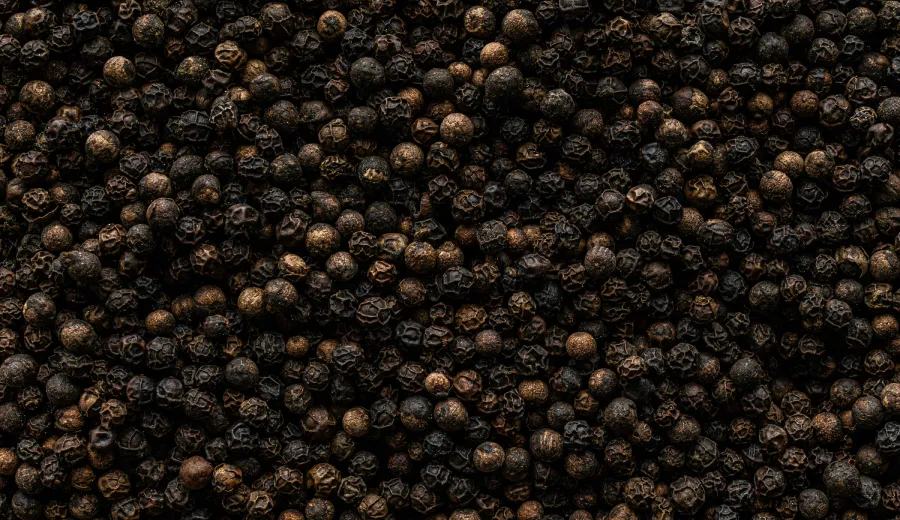
Pepper is sourced in black and white forms, a procurement decision that may require different supplier qualifications. Filter by piperine content on Nutrada to find GFSI-certified suppliers and request bulk quotes.
| Value | Description |
| Botanical name | Piper nigrum |
| Available forms | Whole black, ground, cracked, white pepper |
| Origins | Vietnam, India, Indonesia, Brazil |
| Certifications | GFSI (BRCGS, IFS, FSSC 22000), EU Organic, Kosher, Halal |
| Common applications | Universal seasoning, ready meals, sauces, meat products, supplements |
| Packaging | 5-25 kg bags |
| MOQ | 25kg |
| Category | Herbs Wholesale |
| Form/Type | What it means for procurement | Typical application |
| Black pepper whole | Unripe berries dried with skin - highest piperine content (7-9%) | Spice grinding, slow-cooked dishes, restaurant kitchens |
| White pepper | Ripe berries with skin removed - milder flavor profile | Light-colored foods, European cuisine, delicate sauces |
| Ground black pepper | Pre-milled for immediate use - shorter shelf life | Food manufacturing, ready meals, seasoning blends |
| Cracked pepper | Coarsely broken texture - visual appeal | Marinades, spice mixes, artisanal food products |
| Green pepper | Unripe berries preserved fresh - specialty positioning | Gourmet applications, specialty sauces |
| Grade | ASTA specification | Procurement relevance |
| Standard black | Min 500 g/L bulk density | Cost-effective for high-volume food manufacturing |
| Premium black | 550-570 g/L bulk density | Restaurant chains, premium spice blends |
| Tellicherry | Berries ≥4.25mm diameter | Quality positioning, European spice blenders |
| Muntok white | Indonesian origin specification | Traditional European white pepper applications |
India's Malabar and Tellicherry pepper from Kerala commands a quality premium in EU markets, with Tellicherry grade berries measuring ≥4.25mm diameter prized by European spice blenders. Vietnam dominates global supply at approximately 40% of world production, concentrated in the Central Highlands provinces of Gia Lai, Dak Lak, and Dak Nong. Brazil serves as the second-largest exporter with production centered in Pará state, where exports to Europe grew consistently from 1,300 to 2,200 tonnes between 2020 and 2024. Black pepper is subject to enhanced official controls under Regulation (EU) 2019/1793 for pesticide residues, particularly from certain Asian origins. Indonesian Lampung black and Muntok white pepper offer traditional quality profiles for European spice applications.
Piperine content determines pungency and degrades rapidly when exposed to light and humidity. Standard packaging includes 5-25 kg food-safe bags with moisture barriers for extended shelf life. Store below 15 degrees Celsius at under 65% relative humidity to maintain piperine levels and prevent mold development. Buyers should verify ASTA bulk density grades on the Certificate of Analysis before accepting shipments, as density correlates directly with essential oil content and flavor intensity.
EU Organic certification is available from India (Kerala), Indonesia, and Vietnam through certified processors. Indian organic pepper typically carries dual EU/USDA certification, while Vietnamese organic supply focuses primarily on EU markets. Organic pepper requires separate storage and handling protocols to maintain certification integrity throughout the supply chain.
Consumer packaging formats include glass jars, plastic shakers, sachets, and refill pouches for retail and foodservice channels. Private label pepper production requires selecting between whole and ground formats before packaging begins, as grinding affects shelf life and flavor retention. MOQ typically starts at 1,000 units per SKU depending on packaging format and labeling complexity.
Manufacturers concentrate in Vietnam (Central Highlands), India (Kerala, Karnataka), and Indonesia (Lampung, Bangka-Belitung) with established processing infrastructure for cleaning, drying, and grading. Request batch-specific Certificates of Analysis showing piperine content, moisture levels, and complete pesticide panel results. Food manufacturers sourcing chillies and cumin often work with the same spice processors for consistent supply chain management.
Nutrada lists GFSI-certified pepper suppliers from Vietnam, India, Indonesia, and Brazil, covering whole, ground, and cracked forms across conventional and organic supply. All orders are placed directly with certified suppliers, with no intermediary.
Last updated: Apr 10, 2026

Find the right supplier for your food ingredients in under a minute with Nutrada. Nutrada - Sourcing made easy.