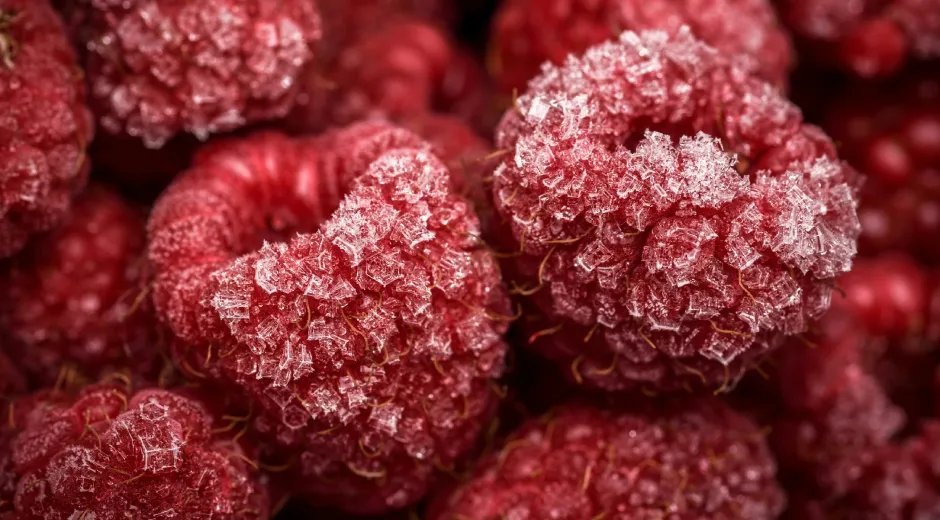
Nutrada lists GFSI-certified frozen raspberry suppliers with individual quick frozen (IQF) and block quick frozen (BQF) specifications so procurement teams can compare and request quotes directly.
| Value | Description |
| Botanical name | Rubus idaeus |
| Available forms | IQF whole berries, BQF crumbles, puree |
| Origins | Poland, Serbia, Chile, USA, Morocco |
| Certifications | GFSI (BRCGS, IFS, FSSC 22000), EU Organic, Kosher, Halal |
| Common applications | Bakery fillings, smoothies, yogurt, ice cream, confectionery |
| Packaging | 10-25kg cartons, palletized |
| MOQ | 20kg |
| Category | Frozen Fruits Wholesale |
| Form | What it means for procurement | Typical application |
| IQF whole berries | Individual berries stay separate when frozen, premium pricing | Retail packs, premium bakery decoration, yogurt inclusion |
| BQF crumbles | Berries frozen in blocks, broken pieces acceptable, lower cost | Jam production, smoothie bases, industrial puree |
| Frozen puree | Pre-processed smooth base, eliminates in-house processing | Beverage manufacture, ice cream base, confectionery filling |
Serbia is the largest third-country supplier of frozen raspberries to the European Union and has historically been the world's leading frozen raspberry exporter by gross volume, with production concentrated in the western Serbian growing zone centred on Arilje, Požega, Ivanjica, and Valjevo.
Harvest of summer-bearing varieties runs primarily from July through August.
Ukraine has emerged as a significant structural force in EU frozen raspberry supply, in 2024, Ukraine surpassed Serbia and Poland in net export volumes (65,000 tonnes net, compared to Serbia's 63,000 tonnes net), with direct exports to Germany, France, and Austria growing sharply.
Poland remains an important processing and distribution hub with extensive IQF infrastructure, but its domestic production base has declined substantially and now relies on imported Ukrainian raw material for over half its total export volume, making it primarily a re-processing rather than a domestic-origin source.
All frozen raspberry must be stored at -18°C or below under EU quick-frozen food legislation.
Cold chain integrity below -18 degrees Celsius prevents quality degradation during transport and storage. Packaging in 10-25kg cartons with polyethylene liners maintains berry integrity during palletized shipment. Check the freezing date on shipping documentation as frozen raspberries maintain optimal color and texture for 18-24 months from initial freezing.
Polish and Serbian suppliers hold both EU Organic and USDA NOP certifications with limited seasonal availability. Organic frozen raspberry supply requires advance planning as certified volumes represent approximately 15% of conventional production capacity.
Consumer formats include 250g-1kg retail pouches, stand-up bags, and resealable containers suitable for retail frozen sections. HORECA packaging spans 2.5-5kg formats for restaurant and foodservice applications. MOQ for private label typically requires 500-1000kg minimum production runs depending on packaging format.
Processors concentrate in Poland and Serbia where raspberry cultivation meets established freezing infrastructure. Request batch-specific certificates of analysis covering microbiological parameters, pesticide residue testing, and Brix measurements for juice applications.
Nutrada lists GFSI-certified frozen raspberry suppliers from major origins, covering IQF, BQF, and puree formats across conventional and organic supply. All orders are placed directly with certified suppliers, with no intermediary.
Last updated: Apr 7, 2026

Find the right supplier for your food ingredients in under a minute with Nutrada. Nutrada - Sourcing made easy.