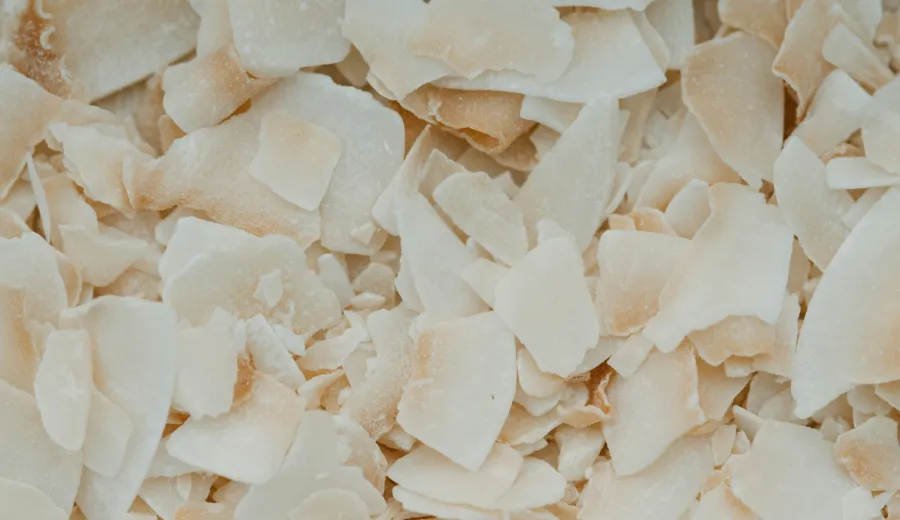
Philippines and Indonesia account for the majority of European desiccated coconut supply. Find GFSI-certified wholesale coconut suppliers from both origins on Nutrada, filterable by grade and MOQ.
| Field | Detail |
| Botanical name | Cocos nucifera |
| Available forms | Desiccated (fine, medium, coarse), flakes, chips, flour, milk powder |
| Origins | Philippines, Indonesia, India, Sri Lanka, Thailand, Malaysia |
| Certifications | GFSI (BRCGS, IFS, FSSC 22000), EU Organic, USDA NOP, Kosher, Halal, Rainforest Alliance, Fairtrade |
| Common applications | Bakery, confectionery, muesli, granola, snack coatings, gluten-free baking |
| Packaging | 20-25kg bags and boxes |
| MOQ | 25kg |
| Category | Dried Fruits Wholesale |
Coconut forms differ by particle size and fat content, affecting application suitability and supplier qualifications required.
| Form/Grade | What it means for procurement | Typical application |
| Desiccated fine | Moisture max 3%, fat 60-65%, finest particle size | Baking, cake mixes, coconut macaroons |
| Desiccated medium | Same moisture/fat specs, medium particle size | Granola, muesli, confectionery coatings |
| Desiccated coarse | Same moisture/fat specs, largest particle size | Garnish, texture applications, Bounty-type bars |
| Coconut flakes | Larger shavings, toasted or untoasted available | Breakfast cereals, trail mixes |
| Coconut chips | Thick slices, typically toasted | Premium snacks, yogurt toppings |
| Coconut flour | Defatted, fine powder, different spec entirely | Gluten-free baking, low-carb recipes |
| Coconut milk powder | Spray-dried, higher fat than flour | Curry pastes, beverage applications |
The Philippines is the EU's largest supplier of desiccated coconut, accounting for 40% of EU coconut imports in 2023 according to Eurostat, with processing concentrated across the country's major coconut-growing regions.
Indonesia follows as the second-largest EU supplier at 17% of import volumes, with processing infrastructure concentrated in Java and Sumatra. Ivory Coast and Sri Lanka each account for approximately 8% of EU coconut imports and represent established supply routes into European markets, with Sri Lanka maintaining a long-standing desiccated coconut export industry. Vietnam accounts for a further 8% of EU imports. India is among the world's three largest coconut producers by cultivation area, with significant organic certification infrastructure in Kerala and Tamil Nadu, though its share of EU desiccated coconut imports is smaller than the leading Southeast Asian and West African origins.
Procurement teams sourcing desiccated coconut alongside other tropical dried ingredients also frequently evaluate dried mango and dried pineapple, given the overlapping supplier networks across Philippine and Southeast Asian processors.
Desiccated coconut is hygroscopic and requires storage below 20 degrees Celsius with relative humidity under 65% to prevent mould growth. Standard packaging uses 20-25kg multi-wall paper sacks with polyethylene inner liners. Shelf life ranges from 12 months at ambient temperature to 18 months under controlled conditions. Verify the moisture content on each batch CoA before accepting delivery, as products above 3% moisture will develop mould and rancidity within weeks.
Philippines, Sri Lanka, and India all offer EU Organic certified desiccated coconut with well-established certification infrastructure. Philippine suppliers frequently hold dual EU/USDA NOP certification, while Sri Lankan organic coconut benefits from the country's integrated organic agriculture programmes. Indian organic supply from Kerala estates often includes additional Rainforest Alliance certification alongside organic status.
Consumer packaging formats include resealable pouches for baking applications, clear jars for retail visibility, and sachets for single-use portions in cooking ingredients. MOQs for private label coconut products typically start at 5,000 units, higher than bulk purchasing. Fix the particle size specification before production starts, as switching between fine, medium, and coarse grates requires different production line settings.
Coconut processors are concentrated in the Philippines, Indonesia, India, and Sri Lanka, with established food safety infrastructure supporting European market requirements. Request batch-specific CoAs showing moisture content, free fatty acid levels, and microbiological results.
Nutrada lists GFSI-certified coconut suppliers from all major origins, covering desiccated, flakes, chips, flour, and milk powder across conventional and organic supply. All orders are placed directly with certified suppliers, with no intermediary.
Further reading:
Last updated: Apr 6, 2026

Find the right supplier for your food ingredients in under a minute with Nutrada. Nutrada - Sourcing made easy.