Millets are a diverse group of small-seeded grasses cultivated primarily in semi-arid regions of Asia and Africa. The five commercially significant types for European food manufacturers are pearl millet (Pennisetum glaucum), finger millet (Eleusine coracana), foxtail millet (Setaria italica), proso millet (Panicum miliaceum), and barnyard millet (Echinochloa frumentacea). Each has different origin profiles, culinary applications, and commercial availability. Nutrada lists GFSI-certified millet suppliers across Indian, African, and Eastern European origins, searchable by certification, processing form, and minimum order quantity.
In short:
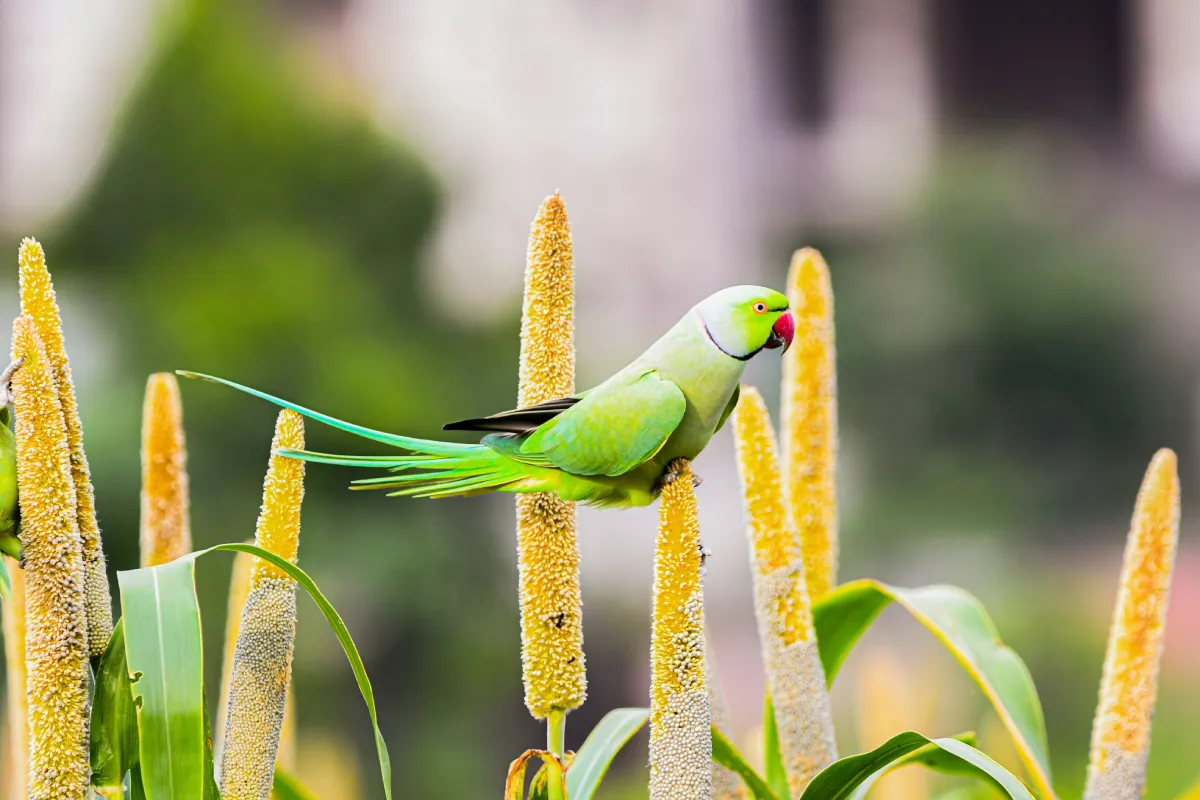
Pearl millet (Pennisetum glaucum), known as bajra in India and mahangu in parts of Southern Africa, is the most widely cultivated millet globally. It accounts for approximately 50 % of world millet production and is the primary grain source for millions of smallholder farmers in the semi-arid Sahel and Indian Deccan plateau.
The grain is small, round, and ranges from light grey to dark grey or pearl-white depending on the variety. Protein content typically is 10-13 % on a dry-matter basis, which is the highest among the commonly traded millets. Iron content is notably high at approximately 8 mg per 100 grams in traditional varieties, with biofortified varieties developed by ICRISAT and partners reaching 9-10 mg per 100 grams. This iron density is why pearl millet is often targeted in nutrition programmes addressing iron-deficiency anaemia.
For food manufacturing, pearl millet is used whole in porridges, milled into flour for African flatbreads (injera-style products, tô, and kisra) and Indian rotis, and increasingly in gluten-free bakery and snack formulations in Western markets. The flavour is earthy and mildly nutty, which suits savoury applications better than neutral-flavour formulations.
Finger millet (Eleusine coracana), called ragi in India and dagussa in Ethiopia, is native to the highlands of East Africa and was domesticated before the third millennium BC. It is grown primarily in India, Uganda, Kenya, Tanzania, Ethiopia, and Nepal.
The grain is small, roughly 1-2 mm in diameter, and ranges from reddish-brown to dark reddish-purple in colour. Finger millet is exceptional for its calcium content. Published data puts ragi at approximately 344 mg of calcium per 100 grams, which is several times higher than any other cereal. This has made it a traditional weaning food and a staple in vegetarian diets where dairy is absent or limited. Protein content runs 7-8 %, lower than pearl millet but with a complete amino acid profile that includes notable levels of methionine and tryptophan.
Commercial formats for finger millet include whole grain, ragi flour, malted ragi (used in infant and elderly nutrition products), and pre-gelatinised ragi for instant porridges. In Europe, finger millet is typically imported from India as ragi flour for the ethnic food market and for specialty gluten-free bakery.
Foxtail millet (Setaria italica) is the second most widely cultivated millet globally. China is the largest producer, with significant production also in India, Indonesia, Korea, and parts of southern Europe. The name comes from the tapered, bristly flower head that resembles a fox's tail.
The grain is small and yellow to pale yellow. Protein content sits at 11-12 %. Foxtail millet has one of the lower glycemic indexes among the millets (estimated GI of 50-55 for cooked whole grain), which has made it a focus of diabetic and glycemic-control positioning in Asian consumer markets and increasingly in Western functional food. It is the closest millet substitute for white rice in terms of texture and cooking behaviour, which matters for formulations developed as rice replacements.
Proso millet (Panicum miliaceum), also called common millet, broomcorn millet, or white millet, is grown across a wide temperate range, including the United States (Colorado, Nebraska, South and North Dakota), Russia, Ukraine, Kazakhstan, China, India, and parts of Western Europe. It is the millet most commonly traded in bulk international commodity markets and dominates the pet-bird-food segment.
The grain is small, round, and typically white to pale cream, with red and golden varieties also in production. The protein content is 11-12 % with a mild, slightly nutty flavour that suits neutral formulations. Proso millet has one of the shortest growing seasons of any cereal (approximately 60-80 days from planting to harvest), which makes it valuable in double-cropping and drought-break rotations.
For food manufacturing, proso millet is used in breakfast cereals, multigrain breads, porridge mixes, and gluten-free baking. It is also fermented into traditional beverages (kvass in Russia, jiu niang porridge in China).
Barnyard millet (Echinochloa frumentacea or Echinochloa esculenta, also called Japanese millet or kuthiraivali in Tamil) is grown across India, China, Japan, Korea, Australia, and parts of Sub-Saharan Africa. It is one of the fastest-maturing cereals, ready for harvest in 45-65 days after sowing.
The grain is among the smallest of the millets at roughly 1-1.5 mm in diameter, with a characteristic small black spot on each kernel. The protein content is 10-11 %. Barnyard millet has the lowest reported glycemic index among the common millets, with some studies putting it around GI 41-45 for cooked whole grain, which has positioned it as the millet of choice in diabetic-targeted formulations in the Indian market.
| Type | Botanical Name | Main Origins | Protein | Notes |
| Pearl millet (bajra) | Pennisetum glaucum | India, Nigeria, Niger, Mali, Burkina Faso | 10-13% | Highest iron density; dominant African staple |
| Finger millet (ragi) | Eleusine coracana | India, Uganda, Kenya, Ethiopia, Nepal | 7-8% | Exceptional calcium (~344 mg/100g); common weaning food |
| Foxtail millet | Setaria italica | China, India, Korea, southern Europe | 11-12% | Low GI; closest rice substitute |
| Proso millet | Panicum miliaceum | USA, Russia, Ukraine, China, India | 11-12% | Most liquid bulk trade; neutral flavour |
| Barnyard millet | Echinochloa frumentacea | India, China, Japan, Korea | 10-11% | Lowest GI reported; fasting-food tradition [VERIFY] |
India is the world's largest millet producer by volume, contributing approximately 43 % of global output. Indian production in 2020-21 included 11.4 million tonnes of pearl millet, 3.8 million tonnes of finger millet, 2.0 million tonnes of proso millet, and 0.7 million tonnes of foxtail millet, alongside 10.4 million tonnes of sorghum (often classed as a great millet). Andhra Pradesh, Karnataka, Rajasthan, Tamil Nadu, and Maharashtra are the main producing states.
Africa is the second major production region. Nigeria, Niger, Mali, Burkina Faso, and Senegal are the leading pearl millet producers in West Africa, with production concentrated in the Sahel. Uganda, Kenya, Tanzania, and Ethiopia produce finger millet. African production is predominantly smallholder and subsistence-focused, with limited export volume reaching EU food manufacturers.
China is the largest producer of foxtail millet and a significant producer of proso millet. North American production of proso millet is concentrated in Colorado, Nebraska, and the Dakotas, historically for the pet-bird-food market but increasingly for food-grade exports following the IYM 2023 demand uplift. Russia, Ukraine, and Kazakhstan produce proso millet for both domestic food and export.
All common millets (pearl, finger, foxtail, proso, barnyard, little, kodo, browntop, guinea) are naturally gluten-free. They do not contain the gluten storage proteins (gliadin in wheat, hordein in barley, secalin in rye) that trigger coeliac disease. Millets can therefore support a gluten-free claim under EU labelling rules.
Under Regulation (EU) No 1169/2011 on food information to consumers, combined with the specific gluten-free labelling rules in Regulation (EU) No 828/2014, foods can carry a gluten-free claim if they contain no more than 20 mg/kg of gluten in the food as sold. For millet-based products, meeting this threshold is less about the grain itself and more about cross-contamination control. Milling facilities that handle wheat, rye, or barley on the same lines will require validated cleaning protocols, allergen testing, and in many cases a segregated milling line to support a gluten-free claim.
Contaminant limits under Regulation (EU) 2023/915 (which replaced Regulation (EC) No 1881/2006) cover mycotoxins including aflatoxin B1, fumonisins, and deoxynivalenol relevant to stored grains. Pesticide maximum residue levels fall under Regulation (EC) No 396/2005. For Indian-origin finger millet in particular, buyers should request documentation on pesticide residues (organochlorine compounds and triazole fungicides have both appeared in RASFF notifications historically) and on mycotoxins, since storage conditions in humid climates elevate aflatoxin risk.
Organic certification under Regulation (EU) 2018/848 is available for Indian and African origins, though supply is thinner than for mainstream cereals. USDA NOP certification is more common for US-origin proso millet. Kosher and Halal certification are routine across all origins.
Specify the type precisely. Asking for millet without specifying pearl, finger, foxtail, proso, or barnyard leaves too much ambiguity for a supplier to respond with a firm offer. If the formulation calls for a specific glycemic profile or calcium content, the type choice is not interchangeable.
Standard specifications for food-grade dehulled millet include moisture below 12 %, admixture below 1 %, foreign matter below 0.5 %, broken grain below 2-3 %, and passed pesticide and mycotoxin screens against EU limits. For flour, specify extraction rate, particle size distribution, and moisture. Most reputable suppliers will provide a certificate of analysis per lot; request the analysis before shipment rather than on arrival.
MOQ varies significantly by type and origin. Pearl and proso millet are bulk commodity products available in full-container loads (approximately 24-28 tonnes) from Indian and Eastern European exporters. Finger millet, foxtail, and barnyard are often ordered at pallet scale (approximately 1 tonne) from European distributors stocking Indian origins, or at 5-10 tonne minimums direct from Indian mills.
Red flags to watch for: suppliers who cannot confirm the botanical species of the grain being offered (a real sign of an intermediary trading unknown lots); missing pesticide residue certificates on Indian-origin finger millet; generic gluten-free claims on milling facilities that also handle wheat without documented segregation; and pricing that sits well below the typical market level, which often signals mixed-grain lots or storage issues.
Buyers sourcing millet can often consolidate with other gluten-free grains including sorghum from the same Indian or African suppliers.
Breakfast cereal and granola manufacturing has been the fastest-growing category for millets in European formulations since 2023. Puffed pearl millet and puffed proso are used as texture and visual-cue inclusions in muesli and granola. Foxtail and proso millet flakes substitute for a portion of oat flakes in gluten-free muesli.
Gluten-free bakery uses finger millet flour, pearl millet flour, and foxtail millet flour as part of multi-grain blends (typically combined with rice flour, sorghum flour, tapioca starch, and a hydrocolloid such as psyllium or xanthan). Pure millet flour does not produce a well-structured loaf because it lacks both gluten and the starch-binding properties of wheat; millet flour should sit at 20-40 % of a gluten-free blend rather than as the sole flour.
Snack and crisp manufacturing uses puffed millet in extruded snacks, bars, and clusters. Pearl and proso are most common. For bar applications, the crunch profile and low bitterness of proso millet suit neutral-flavour recipes; pearl millet's earthy note works better in savoury and spice-forward products.
Brewing applications for millet are developing but small relative to barley or wheat. Pearl millet malt has been used in sorghum-based gluten-free beers and in traditional African brews. This remains a specialty segment rather than a mainstream procurement category.
Plant-based protein formulations increasingly use millet as a rice substitute in protein-plus-grain bases. Foxtail millet's GI profile and pearl millet's iron density are both positioning drivers here, particularly in products targeting women's nutrition or vegan diets.
Yes. Pearl, finger, foxtail, proso, barnyard, little, kodo, browntop, and guinea millets are all naturally gluten-free. Sorghum, sometimes called great millet, is also gluten-free. The risk to a gluten-free claim comes almost entirely from cross-contamination at the milling and packing stage, not from the grain itself. Buyers need documented segregation protocols on any facility that also handles wheat, barley, rye, spelt, kamut, or triticale.
Pearl millet typically has the highest protein content at 10-13 % on a dry-matter basis. Foxtail and proso follow at 11-12 %. Finger millet is lowest among the common millets at 7-8 %, but its amino acid profile includes higher methionine and tryptophan than most other cereals, which makes it nutritionally valuable despite the lower total protein figure.
Not cleanly. Each type has different absorption rates, cook times, flavour profiles, and colour outcomes. Finger millet turns a finished product reddish-brown; pearl millet turns it greyish; proso and foxtail leave it pale. Cook times vary by 20-40 % between types.
Whole dehulled millet in paper-lined 25 kg bags kept at below 15 degrees Celsius and below 65 % relative humidity typically holds for 12 months. Pearled and broken grain hold for 6-9 months before the fat fraction starts to oxidise noticeably, which shows as a soapy or rancid flavour. Millet flour has a shorter shelf life (3-6 months) because the larger surface area accelerates lipid oxidation. For longer shelf life, vacuum packaging or nitrogen-flushed packaging extends the window by 3-6 months.
Yes, and the effect outlasted the year itself. The FAO-led IYM 2023, proposed by the Indian government and endorsed by the UN General Assembly, raised retailer and manufacturer awareness enough that many European retailers now carry millet-based breakfast cereals, flours, and ready-meal inclusions that they did not stock before 2023.


Find the right supplier for your food ingredients in under a minute with Nutrada. Nutrada - Sourcing made easy.