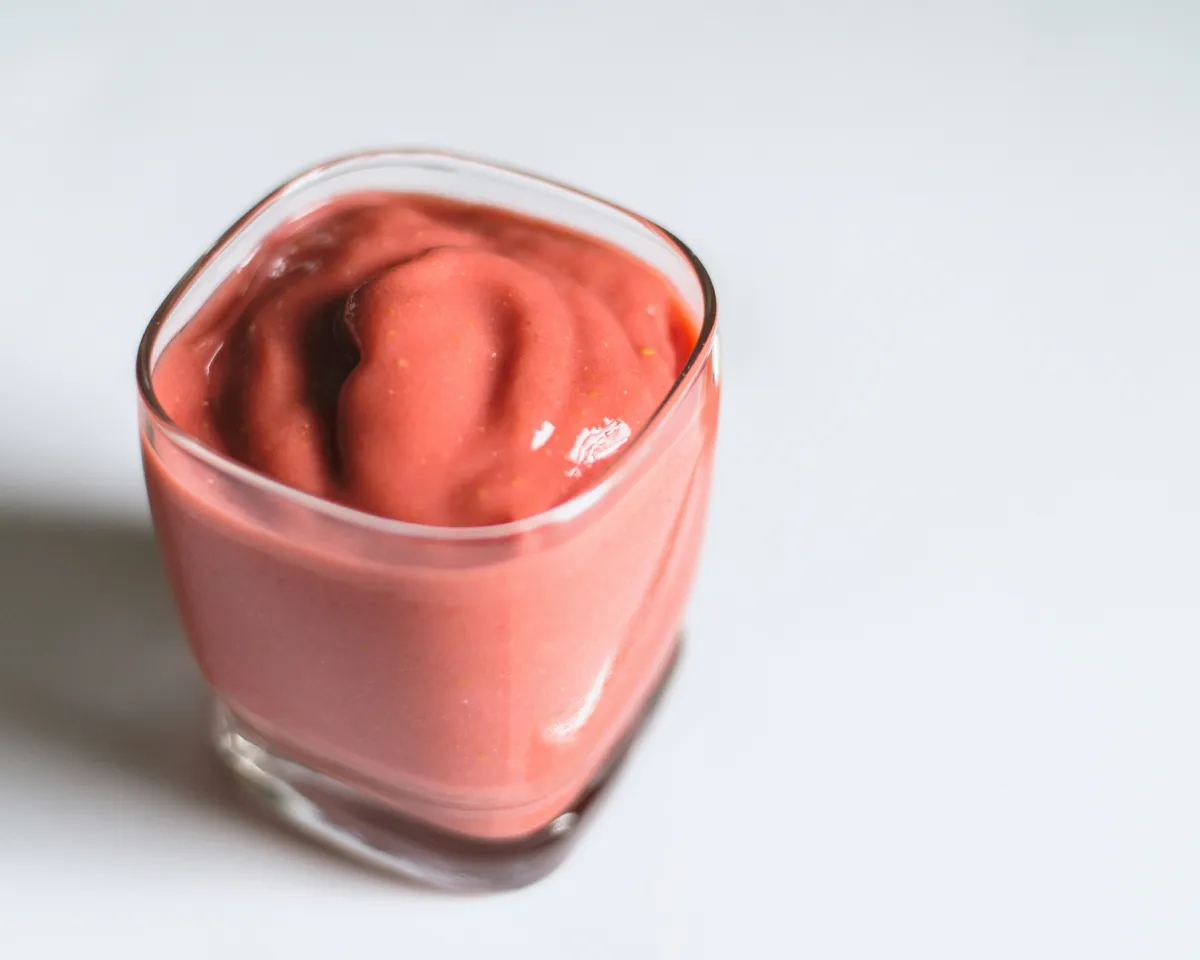
Aseptic and frozen fruit purees are the two dominant commercial formats for buying fruit puree in bulk. Aseptic puree is shelf-stable at ambient temperature in sealed bag-in-box or bag-in-drum formats. Frozen puree is stored at minus 18 degrees Celsius in pails, blocks, or drums. Each format suits different applications and supply chain trajectories. Nutrada lists GFSI-certified aseptic and frozen fruit puree suppliers across European, Latin American, and Asian origins, searchable by certification, MOQ, and packaging format.
In short:
Aseptic processing combines two steps done in parallel. The puree is thermally sterilised by flash-heating through a tube sterilizer, typically at 90-110 degrees Celsius for several seconds to roughly one minute, depending on fruit pH and viscosity. It is then cooled rapidly and filled into a pre-sterilised bag inside a sealed aseptic chamber. Because both the product and the package are commercially sterile at the moment of sealing, no preservatives or refrigeration are needed for shelf life.
The standard industrial formats are bag-in-drum (BID) at 200 or 220 litres, bag-in-box (BIB) at 1 to 25 litres for smaller users, and IBC’s at 1000 and 1500 litres for high-throughput processors. Bag materials are multilayer laminates combining polyethylene, metallised PET, and aluminium foil in various configurations. The aluminium barrier is what makes long ambient shelf life possible. It prevents oxygen ingress that would otherwise oxidise vitamin C, anthocyanins, and volatile flavour compounds.
For acidic fruits (most berries, citrus, apple, pineapple), pasteurisation temperatures around 85-95 degrees Celsius for 15-60 seconds are typical and sufficient for a 5-log reduction of vegetative pathogens. For lower-acid products like banana, papaya, or tropical blends, more aggressive thermal treatments are required, sometimes combined with pH adjustment.
The thermal step also inactivates endogenous enzymes that cause storage deterioration: pectin methylesterase (PME), polygalacturonase (PG), polyphenol oxidase (PPO), and peroxidase (POD). PME inactivation is the limiting target for most purees because it has the highest thermal stability of the cloud-stability enzymes. Research on apricot PME found the enzyme retains activity up to 80 degrees Celsius for 10 minutes, requiring pasteurisation at 88-93 degrees Celsius for reliable inactivation. Pineapple juice PME requires 70-95 degrees Celsius depending on hold time. Each fruit and pH combination has its own inactivation curve, which is why a reputable aseptic packer should have validated pasteurisation schedules for every product they handle.
Frozen puree is produced by crushing, pulping, and for most products passing the fruit through a finisher to remove skins, seeds, and fibres. The resulting liquid is blast-frozen or plate-frozen at minus 30 to minus 40 degrees Celsius and held at minus 18 degrees Celsius or colder through transport and storage until the buyer thaws it.
Thermal treatment of frozen puree varies. Some products are enzyme-inactivated before freezing (a short heat pulse at 85-90 degrees Celsius for one to two minutes), which stabilises colour and cloud during frozen storage and makes the product easier to handle at defrost. Others are frozen raw-pack with no thermal step, preserving maximum fresh-fruit character but leaving residual enzyme activity that limits shelf life and requires careful temperature control. Raw-pack products are the reason some buyers specify frozen in the first place.
Frozen puree formats run a broader range than aseptic: 1 kg retail-ready blocks, 10 kg pails, 20 kg pails, 180-220 kg drums, and 1 tonne IBC’s. The small-format options matter for R&D, pilot production, and niche product lines where a 200 litre aseptic drum commits more inventory than the buyer can turn over in a reasonable timeframe.
| Factor | Aseptic Puree | Frozen Puree |
| Storage temperature | Ambient, below 24°C | Minus 18°C throughout chain |
| Unopened shelf life | 12-24 months | 12-24 months |
| Shelf life after opening / thawing | 5 days refrigerated in bag; 6 months if refrozen | 5-7 days refrigerated after full thaw |
| Thermal treatment | Flash pasteurisation (85-110°C for seconds) | Optional enzyme inactivation; often raw-pack |
| Typical packaging formats | BIB 1-25L, BID 200/220L, IBC 1000/1500L | 1 kg blocks, 10-20 kg pails, 180-220 kg drums, 1 tonne totes |
| Minimum order | 1 drum (~240 kg) or pallet of BIB | 1 kg block possible from some suppliers |
| Cold chain required | No | Yes, minus 18°C start to end |
| Colour and aroma retention | Reduced (particularly red berries and tropicals) | Higher, particularly raw-pack |
| Ready to use after opening | Yes, pour directly | Controlled thawing required (12-24 hours refrigerated, or continuous tempering) |
| Warehouse cost | Ambient pallet storage | Frozen storage 15-25 EUR/pallet/month |
| Best fit applications | Beverages, sauces, RTD, breweries, smoothie bars | Bakery, dairy, premium ice cream, portioned use |
Aseptic wins on logistics cost and predictability. No refrigerated transport, no cold-storage warehousing, no thawing schedule at the receiving end. For a medium-sized beverage producer running 200-500 kg of puree per day, the savings on cold chain are often significant enough to offset the 10-25 percent per-kg premium that aseptic tends to carry over frozen on comparable fruits.
Aseptic also wins for brewery, kombucha, and hard-seltzer production. The product arrives sterile, requires no defrost time, and can be added directly to the fermenter or finished beverage. This eliminates both a food safety hazard (thaw contamination) and a scheduling constraint (defrost capacity). Aseptic mango puree in 220 kg drums, for example, is now the dominant format for US craft brewers producing fruited sours, and the same shift is visible in European craft breweries.
For long-run stable SKUs with predictable offtake, the longer shelf stability also matters on its own. A brand that uses 5 tonnes of strawberry puree per year can take a single 5-tonne aseptic shipment without paying to keep 5 tonnes of product at minus 18 degrees Celsius for 10 months. Freezer capacity is a hard operating constraint for many mid-sized food manufacturers, and aseptic is often the cleanest way to avoid it.
Frozen wins on flavour and colour retention for heat-sensitive fruits. Raspberry, strawberry, and dark berry purees suffer the most from thermal processing. Anthocyanin pigments degrade, fresh fruit aromas dissipate, and the finished product often has a cooked note that is detectable in cold-served applications like premium ice cream, yogurt, or fruit toppings. For these fruits, a raw-pack frozen puree delivers noticeably better sensory quality.
Frozen also wins on small-format availability. Aseptic is structurally a large-format technology. The machinery and bag costs make sub-25 litre packs economically marginal. Frozen puree in 1 kg blocks or 10 kg pails is how small bakeries, pastry shops, and product developers access puree without committing to larger purchases. For R&D, pilot runs, and limited-edition SKUs, frozen is almost always the only viable format.
Bakery and dairy applications generally favour frozen. Formulations often need puree pre-weighed in small portions, and the slight cooked note in aseptic puree becomes noticeable in neutral, low-flavour bases like Greek yogurt or panna cotta. Premium ice cream manufacturers in particular almost universally specify frozen raw-pack or mildly-pasteurised puree, citing aroma retention as the deciding factor.
Frozen puree is often paired with whole-fruit IQF inclusions in formulations where the puree provides base flavour and IQF pieces provide visible fruit identity. See the IQF guide for specification details on whole-fruit frozen formats. This is the standard approach in fruited yogurt, inclusion ice cream, and layered desserts.
Both formats fall under the same core EU food hygiene framework. Regulation (EC) No 852/2004 covers general hygiene requirements. Regulation (EU) 2023/915, which replaced Regulation (EC) No 1881/2006, sets maximum contaminant levels including mycotoxins, heavy metals, and process contaminants. Regulation (EC) No 396/2005 governs pesticide maximum residue levels on the source fruit.
Aseptic-specific documentation should include the validation of the pasteurisation cycle (temperature-time combination sufficient for a 5-log pathogen reduction), commercial sterility test results on retained samples, and the bag manufacturer's certificate of food-contact compliance. Ask for incubation test records, where filled bags are held at elevated temperature for 7-10 days and checked for microbial growth. That incubation test is the definitive evidence that the aseptic system is performing correctly on a given production run.
Frozen-specific documentation should include the continuous thermal history log through production, freezing, and storage, enzyme inactivation confirmation if the product is heat-treated, and pesticide residue testing on the incoming fruit. Frozen purees for EU market access also fall under Directive 89/108/EEC on quick-frozen foodstuffs, which requires minus 18 degrees Celsius core temperature throughout distribution and appropriate labelling.
For both formats, GFSI-benchmarked certification (BRCGS, IFS, FSSC 22000, SQF) is the baseline buyers should expect from any serious supplier. Organic certification under Regulation (EU) 2018/848 is widely available for major origins. Non-GMO Project verification is increasingly requested in North American supply chains and is worth asking for early in supplier qualification.
Sea freight for frozen products requires refrigerated containers, which run 30-50 percent higher in freight cost than dry containers, and destination storage requires cold-room capacity at 15-25 EUR per pallet per month versus ambient at 4-8 EUR per pallet per month.
For destinations in warm climates (Middle East, Southeast Asia, Sub-Saharan Africa), aseptic becomes materially more attractive because cold chain risk is higher and per-unit cold storage cost is higher. For short-haul European lanes with well-developed frozen logistics, the calculus often still favours frozen on sensory grounds alone. The right answer depends on the fruit, the application, the volume per SKU, and the distance travelled.
Buyers sourcing frozen fruits or puree from the juices, pulp and puree category can typically consolidate multi-fruit shipments under one GFSI certification, simplifying compliance documentation and reducing per-unit handling cost.
Does aseptic puree contain preservatives?
No. The point of aseptic processing is to replace preservatives with commercial sterility. If a product sold as aseptic puree has sodium benzoate, sorbate, or sulfites on the ingredient statement, it is not a true aseptic puree. It is more likely a pasteurised puree in non-sterile packaging. A true aseptic puree should list only fruit, or fruit and ascorbic acid for oxidation-prone fruits like apple and pear.
Can aseptic puree be frozen after opening?
Yes, and it extends usable life significantly. Once the aseptic bag is opened, the aseptic barrier is broken and the remaining product behaves like any non-sterile puree: refrigerate for 5 days, or freeze at minus 18 degrees Celsius for up to 6 months. For buyers who do not use a full 220 kg drum quickly, portioning the opened puree into freezer bags is standard practice.
What is the difference between puree and juice concentrate?
Puree is the whole edible fruit (minus skin, seeds, and cores) pulped and processed without dehydration. Juice concentrate is the liquid juice with most of the water removed, typically to 60-70 degrees Brix, which changes both the sugar profile and the fibre content. A 200 kg drum of mango puree and a 200 kg drum of mango juice concentrate are not interchangeable. The puree has fibre and colour solids and a significantly lower Brix than the concentrate.
What minimum order quantities should I expect for fruit puree in Europe?
For aseptic puree, most reputable EU-based packers offer single-drum orders (200 or 220 litres) as the practical MOQ, with pallet-level quantities (4 drums) at better pricing. For frozen, the MOQ is lower: 10 kg or 20 kg pails from distributors, and drum-level (200 kg) from manufacturers. Importers in Germany, the Netherlands, and Poland typically carry stock in both formats for faster turnaround than manufacturer-direct sourcing.


Find the right supplier for your food ingredients in under a minute with Nutrada. Nutrada - Sourcing made easy.