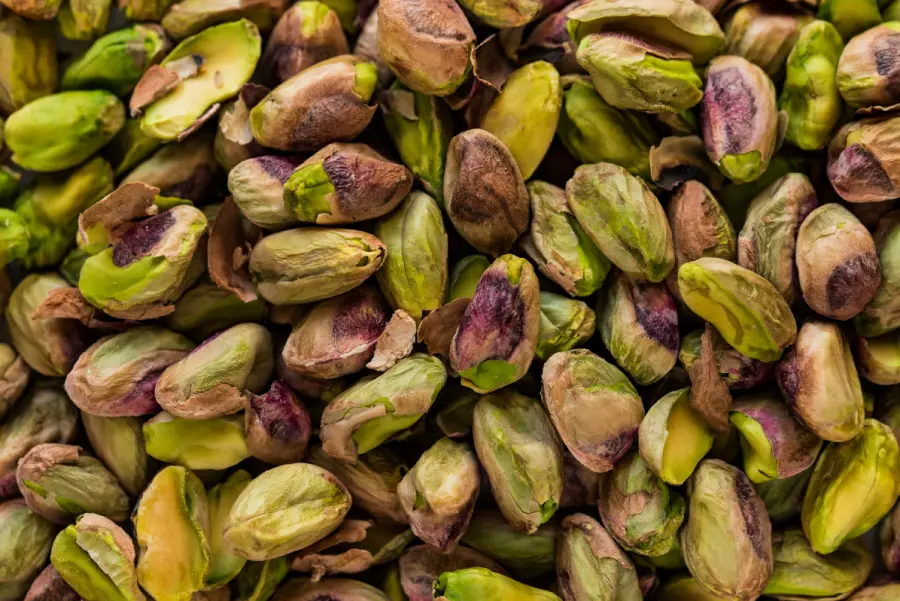
Find GFSI-certified pistachio suppliers on Nutrada offering in-shell, shelled kernels, green peeled powder, and paste from California, Iran, Turkey, and Southern Europe. All pistachio wholesale listings include aflatoxin compliance documentation, moisture specs, and kernel color grade.
| Value | Description |
| Botanical name | Pistacia vera |
| Available forms | In-shell (natural split, mechanically opened), shelled kernels (raw, roasted, salted), green peeled kernels (GPP/GPPK grades A-G), kernel pieces, sliced, slivered, granulated, powder, paste |
| Origins | United States (California), Iran, Turkey, Spain, Greece |
| Certifications | HACCP, IFS, BRC, FSSC 22000, EU Organic, USDA NOP, Halal |
| Common applications | Bakery (cakes, pastries), confectionery, chocolate coating, ice cream, pistachio butter, processed meat (color enhancement), snack mixes, granola bars |
| Packaging | 10-50 kg cartons, 25 kg vacuum-sealed bags |
| MOQ | 10 - 25 kg |
| Category | Nuts Wholesale |
| Form/Grade | What it means for procurement | Typical application |
| In-shell (natural split) | Minimum 95% shell opening rate required (Iranian varieties standard); mechanically opened grade has lower natural split percentage | Snack manufacturing, food service |
| Shelled kernels (raw) | Moisture 5-7%; requires aflatoxin batch testing before shipment | Bakery, confectionery base ingredient |
| Shelled kernels (roasted) | Moisture 2-3%; longer shelf life than raw; extended lead time for roasting | Premium snack brands, nut mixes |
| Green peeled kernels (GPP/GPPK) | Graded A-G by color intensity; Iranian origin dominates this segment due to natural chlorophyll retention | Ice cream, gelato, pistachio cream, high-visibility applications |
| Kernel pieces, sliced, slivered | Lower price point; same aflatoxin requirements as whole kernels | Industrial bakery, granola, meat processing |
| Powder, flour, paste | Requires vacuum or nitrogen packaging; shorter shelf life than whole kernels | Flavor systems, dairy alternatives, spreads |
The USA accounts for 65% of global pistachio production, with harvest concentrated in August through October. US suppliers ship primarily to EU markets requiring strict aflatoxin compliance (max 10 ppb total for ready-to-eat products under Commission Regulation (EC) No 1881/2006).
The PEAR (Pistachio Export Approval and Reporting) program is mandatory for US pistachio shipments to the EU and ensures pre-export aflatoxin testing meets EU thresholds.
Iran supplies 18% of global volume and dominates markets with lenient regulation frameworks. Turkish production (11% of global supply) centers on Gaziantep (Antep) and Siirt provinces, with smaller kernel size but higher oil content than US varieties. Spain and Greece maintain EU-certified organic pistachio supply at lower volume, primarily for regional buyers prioritizing short lead times.
Pistachios are sensitive to moisture absorption and oxidation, which accelerates rancidity and aflatoxin growth if storage humidity exceeds 65%. Suppliers ship in 10-50 kg cartons or 25 kg vacuum-sealed bags. Buyers must verify batch-specific aflatoxin testing results before accepting delivery, as EU and Japanese import authorities reject shipments exceeding regulatory thresholds (10 ppb total aflatoxin for ready-to-eat, 15 ppb for further processing under EU rules; Codex Alimentarius sets AFB1 max 2-4 µg/kg).
Cashew or almond buyers should be familiar with aflatoxin documentation requirements, as the pistachio verification process follows identical protocols.
California, Turkey, Spain, and Greece hold both EU Organic and USDA NOP certification infrastructure for pistachios. Iranian organic pistachio supply exists but dual-certification (EU + USDA) is uncommon due to traceability system gaps. Organic pistachio buyers must confirm whether the supplier holds both certifications if the end market spans US and EU distribution.
Retail formats include resealable pouches (250g, 500g), glass jars, tins, and stand-up bags for in-shell or shelled kernels. Private label MOQs start at 1,000 units but commonly reach 5,000 units when custom roasting, flavoring, or green peeled kernel selection is required.
Buyers must confirm kernel size grade (18/20 to 32/34 pieces per ounce) and aflatoxin testing protocol with the co-packer before production starts.
Pistachio manufacturers are concentrated in California's Central Valley, Gaziantep (Turkey), and Kerman province (Iran), with German and Dutch logistics hubs maintaining regional EU inventory.
Request batch-specific aflatoxin reports, moisture analysis (target 5-7% for raw kernels, 2-3% for roasted), and shell opening rate documentation (minimum 95% for in-shell grades). Color grading certificates are mandatory for green peeled kernel (GPP/GPPK) orders, as color intensity directly affects buyer acceptance in ice cream applications.
Nutrada lists GFSI-certified pistachio suppliers from California, Iran, Turkey, Spain, and Greece, covering in-shell, shelled, green peeled, and paste forms across conventional and organic supply. All orders are placed directly with certified suppliers, with no intermediary.
Last updated: Apr 6, 2026

Find the right supplier for your food ingredients in under a minute with Nutrada. Nutrada - Sourcing made easy.