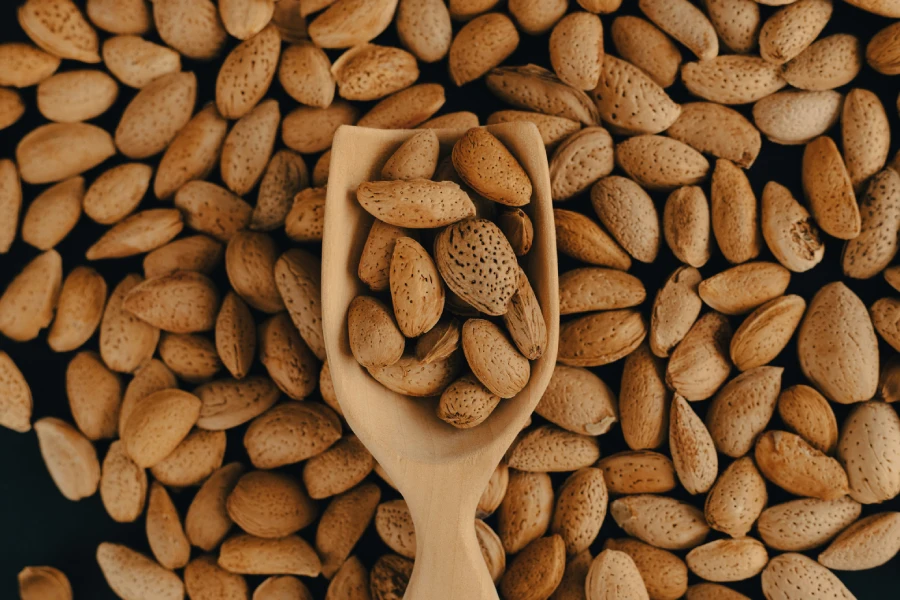
Find GFSI-certified almond suppliers on Nutrada offering blanched whole, natural sliced, and almond flour from California, Spain, and Australia. European almond suppliers provide conventional and organic grades with batch-specific aflatoxin certificates, covering Nonpareil, California-type, and specialty Marcona varieties for confectionery, bakery, and dairy alternative applications.
| Field | Detail |
| Botanical name | Prunus dulcis |
| Available forms | In-shell, natural whole, blanched whole, sliced, slivered, diced, meal/flour, paste/butter |
| Origins | California (USA), Spain, Australia, Italy, Morocco |
| Certifications | GFSI schemes (BRCGS, IFS, FSSC 22000), EU Organic, USDA NOP, Kosher, Halal |
| Common applications | Confectionery, bakery, dairy alternatives, snacks, almond butter, cosmetics |
| Packaging | 25-50 lb cartons, 25kg PE-lined bags, big bags |
| MOQ | 500kg-1MT depending on grade and form |
| Category | Nuts Wholesale |
| Form/Grade | What it means for procurement | Typical application |
| Nonpareil whole | Premium variety with smooth surface, light color. 15-25% price premium over California-type | In-shell retail, slicing, blanching for marzipan |
| California-type (Carmel, Monterey) | Standard commercial grade with wrinkled surface. Lower cost than Nonpareil | Processing, roasting, snack manufacturing |
| Mission-type | Small, intensely flavored variety. Lowest cost category | Flavored snacks, seasonings, industrial applications |
| Blanched whole | Steam/hot water removes brown skin. Critical for white appearance | Marzipan, confectionery, cosmetic-grade applications |
| Sliced natural/blanched | Uniform thickness for consistent baking performance | Cake decoration, frangipane, bakery toppings |
| Almond flour/meal | Finely ground from blanched almonds. Gluten-free certification available | Gluten-free baking, macaron production |
Spanish Marcona almonds command premium pricing (2-3x California Nonpareil) due to round shape and buttery flavor profile preferred in European confectionery.
California dominates global almond supply from Central Valley orchards, accounting for approximately 65% of world production and 80% of exports according to USDA Foreign Agricultural Service. California's water-intensive cultivation creates procurement risk during drought periods when irrigation restrictions reduce yields. Spain produces premium Marcona varieties from Andalusia and Valencia regions, offering European buyers shorter supply chains and counter-seasonal harvest timing. Australia's Murray Valley provides February-April harvest windows that supply fresh almonds when California stocks age, with growing export capacity targeting Asian and European markets. Italy's Sicilian production focuses on specialty varieties including DOP Mandorla di Avola, while Morocco supplies cost-competitive conventional grades primarily to North African and European processors.
Almonds absorb moisture readily and require storage below 6% moisture content to prevent rancidity and mold development. Standard bulk packaging includes 25-50 lb (11-23kg) cartons or 25kg PE-lined kraft bags that protect against humidity while enabling efficient palletization. Buyers must verify suppliers maintain cold storage capabilities below 10°C to preserve oil stability, particularly for blanched forms where protective skin removal accelerates oxidation.
California, Spain, and Italy maintain EU Organic and USDA NOP certified almond orchards, with California offering the deepest organic supply across multiple varieties. Spanish organic Marcona commands premium positioning due to limited acreage and artisanal cultivation methods. Australian organic production remains limited but growing, focusing on Nonpareil varieties for export markets.
Consumer packaging formats include resealable pouches, glass jars, retail bags (100g-1kg), and portion-control sachets for snack applications. Private label MOQ typically starts at 5MT due to packaging line setup requirements. Buyers must specify blanched versus natural skin preference before production as this affects both appearance and shelf life characteristics of the final retail product.
European almond processors concentrate in Spain, Italy, and Germany, providing blanched, sliced, and flour forms with shorter lead times than California imports. Documentation requirements include batch-specific certificates of analysis covering aflatoxin levels (EU limit: 8 µg/kg B1, 10 µg/kg total), microbiological parameters, and pesticide residue screens.
Nutrada lists GFSI-certified almond suppliers from California, Spain, Australia, and Mediterranean origins, covering natural whole, blanched, sliced, and flour forms across conventional and organic supply. All orders are placed directly with certified suppliers, with no intermediary.
Further reading:
Last updated: Mar 31, 2026

Find the right supplier for your food ingredients in under a minute with Nutrada. Nutrada - Sourcing made easy.