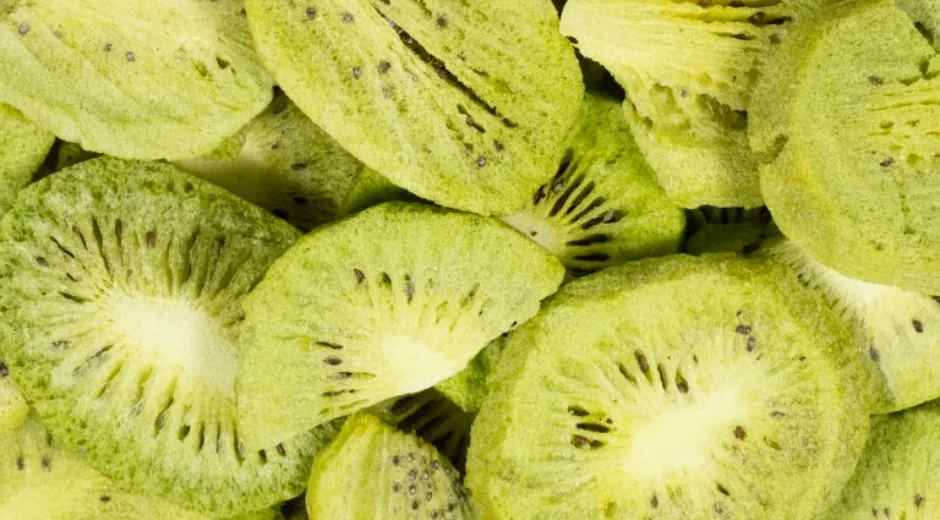
Nutrada lists GFSI-certified Freeze-Dried kiwi suppliers with clear documentation so procurement teams can compare non-declared allergen policies and request quotes directly. Find Freeze-Dried kiwi suppliers from Italy, New Zealand, and Greece offering slices, pieces, and powder formats.
| Value | Description |
| Botanical name | Actinidia deliciosa, A. chinensis |
| Available forms | Slices, pieces, powder, chips |
| Origins | Italy, New Zealand, Greece, China |
| Certifications | GFSI, EU Organic, Kosher, Halal |
| Common applications | Trail mixes, smoothie blends, confectionery |
| Packaging | 5-25kg bags |
| MOQ | 20kg |
| Category | Freeze-Dried Fruits Wholesale |
| Form | What it means for procurement | Typical application |
| Slices | Retains kiwi shape with visible seed pattern | Trail mixes, cereal inclusions |
| Pieces/Chunks | Irregular shapes, lower cost per kg | Smoothie mixes, baking inclusions |
| Powder | Fine particle size, instant solubility | Beverage mixes, flavor systems |
| Chips | Uniform thickness, standard presentation | Direct snacking, confectionery |
| Species | What it means for procurement | Typical application |
| Green kiwi (A. deliciosa) | Higher volume availability, tart flavor profile | Mainstream fruit blends, children's products |
| Golden kiwi (A. chinensis) | Limited supply, sweeter taste, higher cost | Specialty mixes, exotic fruit applications |
New Zealand pioneered commercial kiwifruit and Zespri Gold (SunGold) variety offers enhanced sweetness. Counter-seasonal harvest May-June provides supply when European stock is off-season. Italy is the second-largest kiwi producer globally with Hayward (green) variety from Lazio and Emilia-Romagna dominating supply. Italian kiwi has faced kiwi vine decline (KVD) disease reducing output. Greece has emerged as the EU's second kiwi producer with harvest October-November and Greek organic kiwi certification expanding. China is the world's largest kiwi producer but most output is consumed domestically with EU imports facing standard MRL controls.
Freeze-Dried kiwi is hygroscopic and requires storage below 20 degrees Celsius at under 60% relative humidity to maintain crunch. Standard packaging uses moisture-barrier foil bags inside corrugated boxes. Check with suppliers whether added sugar is included in their standard specification as many processors use sugar to balance the natural tartness. Moisture content should not exceed 4% and shelf life ranges 18-24 months under correct storage conditions.
New Zealand and Italy both offer EU Organic certified Freeze-Dried kiwi with full traceability. Greek organic kiwi supply is expanding but volumes remain limited. Organic certification requires verification of the entire processing chain from fresh fruit through freeze drying equipment cleaning protocols.
Consumer packaging formats include stand-up pouches, snack jars, and portion sachets from 25g to 500g retail sizes. MOQ for private label typically starts at 500kg minimum. Buyers must specify whether voluntary kiwi allergen declaration is required on packaging as kiwi allergy awareness increases among sensitive consumers despite kiwi not being a declared EU allergen.
Manufacturers concentrate in New Zealand, Italy, and China with specialized freeze drying infrastructure. Request batch-specific CoA showing moisture content, vitamin C retention levels, and microbiological parameters including yeast and mold counts. Some facilities process Freeze-Dried pineapple on shared lines for tropical fruit blend applications while others handle Freeze-Dried apple as mild-acid alternatives for children's products.
Nutrada lists GFSI-certified Freeze-Dried kiwi suppliers from Italy, New Zealand, and Greece, covering slices, pieces, and powder across conventional and organic supply. All orders are placed directly with certified suppliers, with no intermediary.
Last updated: Apr 10, 2026
No similar suppliers available.

Find the right supplier for your food ingredients in under a minute with Nutrada. Nutrada - Sourcing made easy.