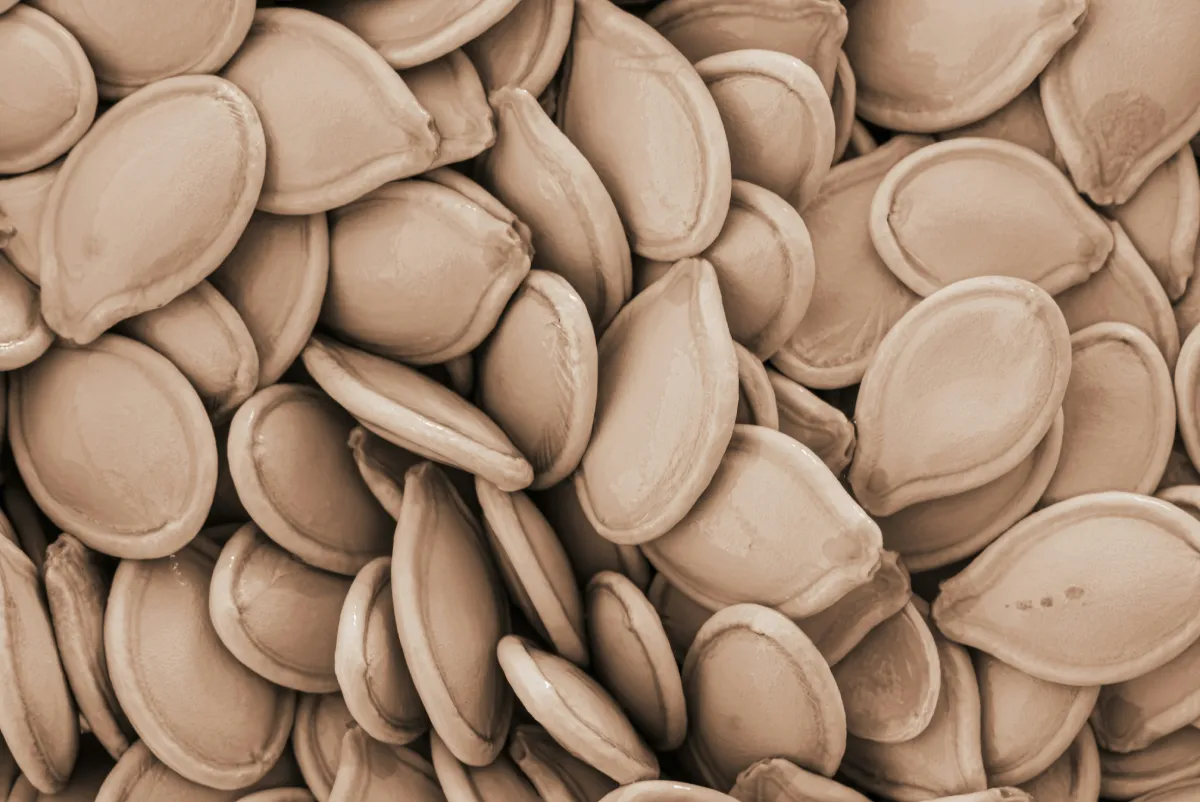
Four pumpkin seed types dominate B2B trade: GWS (Grown Without Shell), Shine Skin, Snow White, and Lady Nail. Each has different hull characteristics, origin profiles, and price points that affect your procurement decision. Nutrada lists GFSI-certified pumpkin seed suppliers across European and Asian origins, searchable by certification and minimum order quantity.
In short:
GWS stands for Grown Without Shell. These seeds come from a pumpkin variety (Cucurbita pepo var. styriaca) that produces kernels with no lignified seed coat. The result is a dark green, hull-less kernel that can be processed directly without a shelling step.
China is the largest GWS exporter, producing an estimated 120,000 tonnes annually from a global total of roughly 200,000 tonnes. Chinese GWS is grown primarily for export, with minimal domestic consumption. Austrian and Ukrainian GWS, often called Styrian pumpkin seeds, come from the original Cucurbita pepo var. styriaca cultivar developed in Austria's Styria region. Styrian seeds carry a Protected Geographical Indication (PGI) when grown and processed in Austria and have a significantly higher price compared to Chinese GWS.
The key procurement difference is oil content. Styrian GWS contains 40-50% oil, compared to typically lower levels in Chinese GWS. This makes Styrian seeds the preferred choice for cold-pressed pumpkin seed oil production, while Chinese GWS covers most food manufacturing applications: bakery inclusions, snack mixes, cereal toppings, and salad garnishes.
GWS is graded by size and visual uniformity. AA grade indicates uniform size and consistent dark green color. A grade allows greater variation in both size and color. Size is measured in mm: common specifications are 9mm+, 10mm+, and 11mm+. Standard moisture is below 8%, and EU-bound shipments must meet aflatoxin limits of 4 ppb (B1) under Regulation (EC) No 1881/2006.
In mainland Europe, GWS is historically the most widely demanded kernel type. Buyers sourcing pumpkin seeds will find that GWS and hulled Shine Skin can often be used interchangeably in formulations, though GWS retains a stronger green hue.
Shine Skin is the most widely grown pumpkin seed variety in China, cultivated primarily for in-shell use and bakery applications. Unlike GWS, Shine Skin seeds have a hull that must be mechanically removed to produce kernels. The hulled kernel is visually similar to GWS but lighter in color, closer to a pale green or yellowish green.
Shine Skin pumpkin plantings in China have increased in recent years due to rising in-shell demand within China and the Middle East. This shift in domestic consumption patterns has historically created price volatility in the export market, when in-shell demand rises, fewer Shine Skin seeds are hulled for kernel export, which can push kernel prices up and pull GWS prices along with them.
GWS pricing typically tracks Shine Skin kernel prices. In theory, GWS should be cheaper because there is no hulling cost. In practice, the price relationship fluctuates with crop yields and demand patterns across both varieties. This is worth tracking if you source both types and need flexibility in your supply chain.
Shine Skin kernels share the same grading structure as GWS: AA, A, and B grades based on size uniformity and color consistency. Purity specifications of 99%+ and moisture below 8% are standard for export-grade product. Shine Skin kernels are graded with the same size thresholds (9mm+, 10mm+), and the same aflatoxin documentation applies.
Snow White pumpkin seeds are an in-shell variety with a distinctive bright white hull. They are larger and flatter than Shine Skin and are traded primarily as a roasted snacking product rather than a kernel ingredient.
China is the main producer. Snow White seeds are typically sold whole (in-shell), either raw or roasted and salted. The white hull makes them visually distinct on retail shelves and in snack mixes, and the seeds are priced at the lower end of the pumpkin seed market compared to GWS and hulled Shine Skin kernels.
For food manufacturers, Snow White seeds are relevant mainly as an in-shell inclusion for trail mixes, snack products, and confectionery. They are not commonly hulled for kernel use because their kernel size and oil content are less suited to food processing applications than GWS or Shine Skin.
Lady Nail seeds are a smaller, elongated variety named for their resemblance to a fingernail shape. They come from a Cucurbita pepo cultivar that produces a thin, easy-to-crack shell and a slim kernel inside.
Turkey and Bulgaria are the primary origins, with Egypt also supplying the market. Lady Nail seeds are almost exclusively traded as an in-shell snacking product, either raw, roasted, or roasted and salted. They are popular across the Middle East, Central Asia, and Eastern European snacking markets.
From a B2B perspective, Lady Nail is a niche product. Typical specifications from Bulgarian suppliers list moisture below 7%, purity above 99%, cadmium below 0.010 mg/kg, and seed counts around 590 pieces per 100g. Standard packaging is 20-25 kg bags or vacuum packing. The shelf life for roasted Lady Nail is typically 6-12 months depending on packaging format.
Lady Nail seeds are not interchangeable with GWS or Shine Skin in manufacturing applications. They serve a different market segment entirely: retail snacking and direct consumption rather than food ingredient supply.
| Specification | GWS | Shine Skin | Snow White | Lady Nail |
| Hull | None (hull-less) | Present, mechanically removed for kernels | Present, white | Present, thin |
| Primary use | Food manufacturing, oil pressing | In-shell snacking, kernels after hulling | In-shell snacking | In-shell snacking |
| Main origins | China, Austria, Ukraine | China | China | Turkey, Bulgaria, Egypt |
| Size grading | AA/A/B by mm (9+, 10+, 11+) | AA/A/B by mm (9+, 10+) | By count per unit weight | By mm (5-8, 7-8, 7-11) |
| Oil content | 40-50% (Styrian), lower (Chinese) | Lower than Styrian GWS | Not typically specified | Not typically specified |
| Moisture spec | Below 8% | Below 8% | Below 10% | Below 7% |
| Price tier | Mid-high (Chinese), premium (Austrian) | Mid | Low-mid | Mid |
| Typical MOQ | 5-25 tonnes | 5-25 tonnes | 5-25 tonnes | 1-25 tonnes |
Pesticide residue documentation is the single most important checkpoint for EU-bound pumpkin seeds. Residues are governed by Regulation (EC) No 396/2005, which sets maximum residue levels (MRLs) for all food products entering the EU market. Chinese-origin seeds carry higher scrutiny at EU borders because pesticide use patterns differ from European cultivation, and RASFF (Rapid Alert System for Food and Feed) notifications for seeds and nuts from China appear regularly.
Austrian and Ukrainian GWS, particularly organic-certified product, typically presents fewer pesticide residue issues due to stricter cultivation practices within the EU framework. The premium you pay for European-origin GWS partly reflects this lower compliance risk.
Beyond pesticide documentation, verify aflatoxin test results (B1 below 2 ppb, total below 4 ppb for EU), moisture at arrival (not just at shipment, transit conditions matter), and size grading against your actual specification rather than relying solely on grade labels. An "AA" from one Chinese processor may not match an "AA" from another.
Buyers sourcing pumpkin seeds alongside sunflower seeds or other grains can often consolidate shipments from the same origin suppliers, reducing logistics costs and simplifying documentation.
Phosphonic acid is a major EU compliance failure on Chinese-origin pumpkin seeds, particularly for organic material.
Phosphonic acid is the residue left behind when potassium phosphonates, disodium phosphonate, or fosetyl-Al are used on a crop. All three degrade to phosphonic acid in the plant. Under the EU's current residue definition in Regulation (EU) 2024/2619 (applicable from 29 April 2025), enforcement is expressed as "phosphonic acid and its salts, expressed as phosphonic acid." For pumpkin seeds, the default limit of quantification sits at 0.2 mg/kg in high-oil matrices.
The organic angle is where this becomes a hard stop. Phosphonic acid is not listed as a permitted input under Regulation (EU) 2021/1165, the regulation governing authorised substances in EU organic production. It cannot legitimately appear in certified organic product above the quantification limit. Peer-reviewed research confirms that plants do not self-produce phosphonic acid; when it is detected, it traces back to external inputs (plant protection products or fertilisers containing phosphonates).
In China, potassium phosphonates are widely used as foliar fertilisers and plant strengtheners, often marketed as "non-pesticide" inputs. The residue carries through harvest, cleaning, and drying unchanged, phosphonic acid is hydrolytically stable under standard processing including pasteurisation, baking, boiling, and sterilisation (EFSA Journal 2021;19(8):6782). This is why Chinese-origin organic pumpkin seed lots regularly fail EU phosphonic acid limits on arrival and end up redirected to markets with less restrictive organic standards.
For procurement:
In most food manufacturing applications, yes. Both produce similar-sized kernels suitable for bakery, snack, and cereal use. The main visible difference is color: GWS kernels are darker green, Shine Skin kernels are lighter. For applications where color matters (salad toppings, visible garnishes), specify which type you need. For baked-in applications where the kernel is not visible, either works.
Austrian Styrian pumpkin seeds have higher oil content (40-50%), carry PGI (Protected Geographical Indication) status, and are grown under EU agricultural regulations. The Styrian oil pumpkin cultivar was developed specifically for oil extraction, and the PGI label guarantees Austrian origin and first-pressing quality. Chinese GWS serves the commodity kernel market at lower price points.
Export-grade pumpkin seeds are typically packed in 25 kg food-safe bags, either PP (polypropylene) or vacuum-sealed for kernels. Vacuum packing extends kernel shelf life by reducing oxidation. Some suppliers offer 1-tonne big bags for large-volume buyers. Roasted in-shell products are packed in smaller units (5-10 kg) for distribution.
Lady Nail seeds are a snacking product and not suitable as a food ingredient in the way GWS or Shine Skin kernels are. The kernel is small, the shell-to-kernel ratio is high, and the seeds are not typically hulled commercially. If your application requires pumpkin seed kernels for formulation, GWS or hulled Shine Skin are the correct product types.
For EU market access, look for BRC, IFS, or FSSC 22000 certification (all GFSI-benchmarked). Organic certification should be EU Organic (Regulation 2018/848) for the European market or USDA Organic for US-bound products. Kosher and Halal certification are available from most established Chinese and Turkish exporters. Always request the actual certificate documents rather than relying on claims.


Find the right supplier for your food ingredients in under a minute with Nutrada. Nutrada - Sourcing made easy.