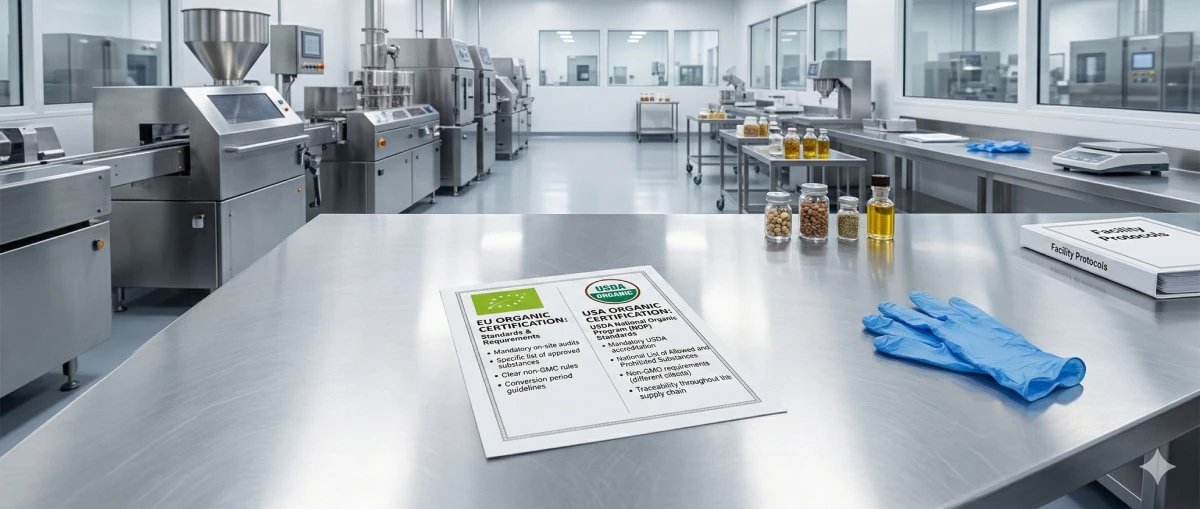
The EU Organic Regulation (2018/848) and the USDA National Organic Program (NOP) are the two most commercially relevant organic standards for food manufacturers operating internationally. While both certify that products are produced without synthetic pesticides, GMOs, and most artificial additives, they differ in specific requirements for inputs, processing aids, labelling thresholds, and import recognition. For manufacturers sourcing organic ingredients or exporting organic products, understanding these differences is essential for compliance and market access.
In short:
Both systems require 95% organic ingredients, but they diverge on how the remaining 5% is handled, how imports are verified, and how strictly residue testing is enforced.
| Parameter | EU Organic (2018/848) | USDA NOP |
| Organic threshold | ≥95% organic agricultural ingredients | ≥95% organic ingredients |
| Non-organic allowance (5%) | Agricultural ingredients only, from approved list | Any ingredient, if organic form unavailable |
| GMO tolerance | 0.9% (adventitious/technically unavoidable) | Zero tolerance for intentional use; same 0.9% threshold in practice |
| Antibiotics in livestock | Restricted, with withdrawal periods | Prohibited entirely |
| Pesticide residue testing | Required under 2022 rules; triggers investigation above threshold | Risk-based; not mandatory on every lot |
| Import framework | Compliance — third-country operators must follow EU rules | Equivalence — accepts certifications from recognised systems |
| Certifying bodies | Must be accredited by EU member state authority | Must be USDA-accredited |
| Logo use | EU organic leaf mandatory on pre-packed EU products | USDA Organic seal voluntary |
| Labelling origin | Must state "EU Agriculture," "non-EU Agriculture," or specific country | Country of origin not required for organic claim |
A practical difference that trips up many manufacturers: the 5% non-organic ingredient allowance works differently in the two systems. Under EU rules, the 5% applies only to agricultural ingredients where an organic version is genuinely unavailable (and this must be documented). Under NOP, the National List specifies which non-organic ingredients are permitted. If you are reformulating a product for dual-market compliance, review both the EU unavailability provisions and the NOP National List for each non-organic ingredient in your recipe.
The EU and US have maintained an organic equivalence arrangement since 2012, allowing organic products certified in one system to be sold as organic in the other. However, this is not a blanket mutual recognition, there are conditions:
For food manufacturers sourcing organic ingredients globally, the safest approach is to require suppliers to hold certification from a body accredited for both EU and NOP standards. Major international certifying bodies like Ecocert, Control Union, Kiwa BCS, and CERES offer dual accreditation.
The shift from “equivalence” to “compliance” for third-country imports under the 2022 regulation is the single biggest change for procurement teams sourcing organic ingredients from outside the EU. Under the old system, a product certified to an “equivalent” national organic standard was accepted. Now, the product must comply with actual EU organic rules, verified by a control body that the European Commission has specifically approved. This has caused real supply disruptions, particularly for organic ingredients from India and Turkey, where some control bodies lost their EU recognition during the transition and suppliers had to switch certifiers.
For ingredients sourced from countries like India, the world’s largest organic producer by number of certified farmers, the compliance requirement has raised both costs and quality assurance standards. Indian organic suppliers who previously operated under equivalence are now subject to more rigorous EU-aligned audits. The long-term effect should be positive for supply chain integrity, but the short-term reality is tighter supply and longer lead times for some organic commodities.
The new EU organic regulation, replacing the previous Regulation 834/2007, introduced several changes relevant to food manufacturers:
The precautionary measures for contamination are worth highlighting because they represent a cultural shift in organic regulation. Previously, finding pesticide residues in an organic product was awkward but not necessarily actionable, there was no formal investigation requirement. Now, any detection triggers a mandatory investigation by the operator and their control body. This means organic ingredient buyers should have a clear protocol for what happens when their incoming quality check detects a residue: who investigates, what documentation is required, and what happens to the affected batch. Having this protocol in place before an incident occurs is much better than improvising during one.
Yes, provided the product meets both standards. The equivalence arrangement facilitates this, but verify that your specific product and its ingredients are covered. The simplest approach is dual certification from a certifying body accredited for both EU organic and USDA NOP.
For an introduction to what organic certification means in practice, see our guide on organic food certification. Many organic ingredient suppliers also exhibit at Biofach, the world's largest organic trade show.
The UK now has its own organic regulation. As of the current framework, the UK recognises EU organic certification for imports. However, EU organic products sold in the UK must comply with UK labelling requirements. Check the latest DEFRA guidance, as recognition arrangements may evolve. Also check in with control bodies such as SOIL Association and OF&G.
For crop-based ingredients, the conversion period is 2 years (EU) or 3 years (US) before the first organic harvest. The certification audit process itself takes 2–6 months. For food manufacturers seeking processing certification, the timeline is shorter, typically 3–6 months for initial audit and approval.
Under EU Regulation 2018/848, finding residues triggers a mandatory investigation to determine the source. If contamination is accidental (drift from neighbouring conventional farms), the product may retain organic status. If intentional use is proven, the product loses organic status. The regulation does not set a specific decertification threshold, which is deliberately flexible.

Find the right supplier for your food ingredients in under a minute with Nutrada. Nutrada - Sourcing made easy.