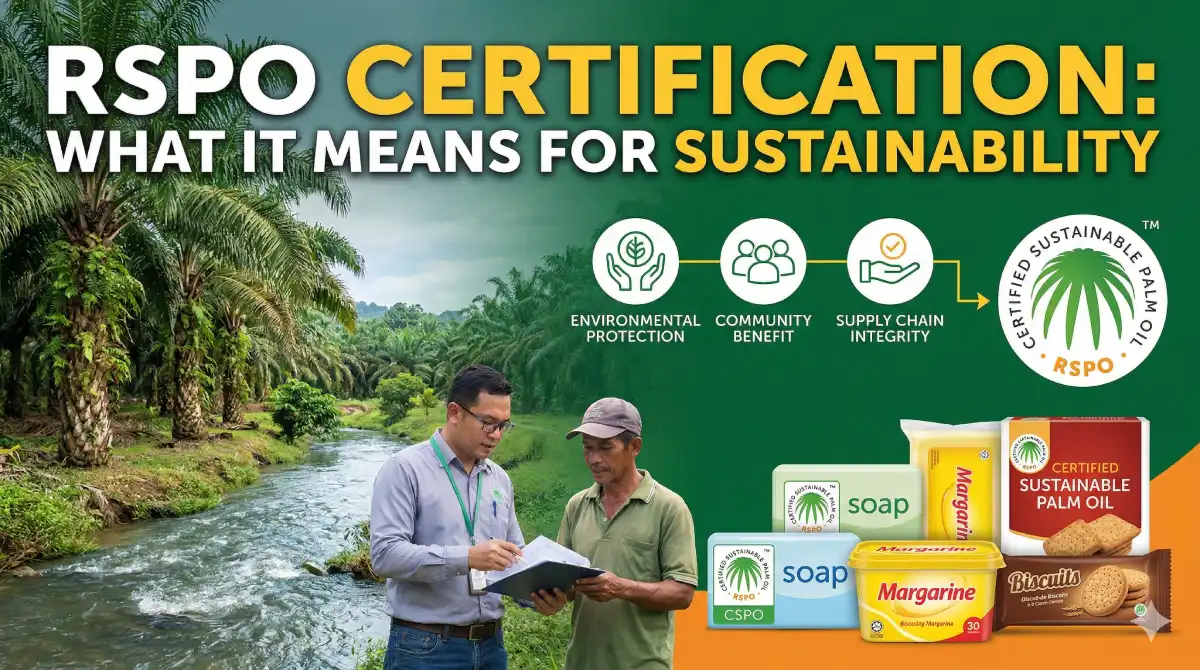
RSPO (Roundtable on Sustainable Palm Oil) is a global certification standard that verifies palm oil production meets environmental and social sustainability criteria. For food manufacturers sourcing palm oil, palm kernel oil, or derivatives, RSPO certification signals that the supply chain avoids deforestation, protects biodiversity, and respects labor rights. This is increasingly becoming a requirement from European retailers and regulators.
In short:
RSPO stands for Roundtable on Sustainable Palm Oil, a multi-stakeholder initiative founded in 2004. It brings together palm oil producers, processors, traders, consumer goods manufacturers, retailers, banks, and NGOs to develop and implement global standards for sustainable palm oil.
The RSPO Principles & Criteria (P&C) cover eight areas: transparency, legal compliance, long-term economic viability, best environmental practices, biodiversity conservation, responsible consideration of employees and communities, responsible development of new plantations, and continuous improvement. Certified plantations undergo third-party audits against these criteria.
As of 2025, RSPO-certified palm oil represents approximately 20% of global palm oil production. While critics argue this is insufficient, for food manufacturers operating in Europe, RSPO is the minimum sustainability credential retailers and consumers expect.
Understanding the four RSPO supply chain models is necessary for procurement decisions, because they determine what you can claim on your packaging and how much traceability costs.
For most European food manufacturers, Segregated (SG) is the practical choice. It provides genuine traceability without the price premium of Identity Preserved, and allows the strongest on-pack claim. Mass Balance is acceptable as a transitional step but faces increasing scrutiny from retailers.
In our experience, buyers who start with Mass Balance often need to upgrade to Segregated within 12-18 months as retailer requirements tighten. If you’re building a new product line, start with SG to avoid reformulation costs later.
Conventional palm oil and RSPO-certified sustainable palm oil are chemically identical, the difference is in how and where the oil was produced. Conventional palm oil may come from plantations established through deforestation, peatland destruction, or exploitative labor practices. RSPO-certified oil comes from plantations audited against sustainability criteria that prohibit these practices.
From a pricing perspective, the premium for RSPO certification depends on the supply chain model. The total impact on finished product cost is typically modest, palm oil represents a small fraction of most food products’ ingredient costs, so even a 15-20% raw material price increase translates to fractions of a cent per unit.
European retailers including major chains in Germany, the UK, Netherlands, and France have public commitments to buy 100% RSPO-certified palm oil. Products containing conventional palm oil face declining shelf access. If you’re looking for palm oil in bulk then head over to our marketplace area where you can find various certified suppliers.
The EU Deforestation Regulation (EUDR) adds another compliance layer beyond RSPO. The EUDR requires companies placing palm oil (and six other commodities) on the EU market to demonstrate that the product is deforestation-free and legally produced, with geolocation data linking to the production plot.
RSPO certification helps meet EUDR requirements but does not guarantee full compliance. The EUDR requires geolocation traceability to the plantation level, which aligns with RSPO Identity Preserved and Segregated models but not Mass Balance or Book & Claim.
Food manufacturers sourcing oils in bulk for the EU market need to prepare for both RSPO and EUDR compliance simultaneously. This means working with suppliers who can provide plantation-level geolocation data alongside their RSPO certification.
Verification is straightforward:
Red flags: suppliers who claim RSPO certification but cannot provide a certificate number, or whose certificate scope doesn’t cover the specific product form you’re buying (crude palm oil certificates don’t automatically cover fractionated products). Reliable suppliers usually also hold GFSI-benchmarked certifications for food safety alongside RSPO for sustainability.
RSPO stands for Roundtable on Sustainable Palm Oil, a global certification standard established in 2004. It certifies that palm oil is produced without causing deforestation, peatland destruction, or labor exploitation. RSPO-certified supply chains undergo third-party audits to verify compliance with environmental and social sustainability criteria.
RSPO-certified palm oil comes from plantations audited against sustainability criteria covering environmental protection, social responsibility, and legal compliance. Four supply chain models (Identity Preserved, Segregated, Mass Balance, Book & Claim) offer different levels of traceability from plantation to finished product. Segregated is the most common model for European food manufacturers.
Sustainable palm oil certified by RSPO addresses the main environmental and social concerns associated with conventional palm oil production. While no certification system is perfect, RSPO-certified palm oil avoids deforestation and peatland destruction. Boycotting palm oil entirely can shift demand to less land-efficient oils, potentially causing greater environmental impact.
The physical and chemical properties are identical, both are palm oil. The difference lies in production practices. RSPO-certified sustainable palm oil comes from audited plantations that meet environmental and social standards. Conventional palm oil carries no such guarantees. The price premium for RSPO certification ranges significantly by supply chain model, volume, and market conditions.

Find the right supplier for your food ingredients in under a minute with Nutrada. Nutrada - Sourcing made easy.