
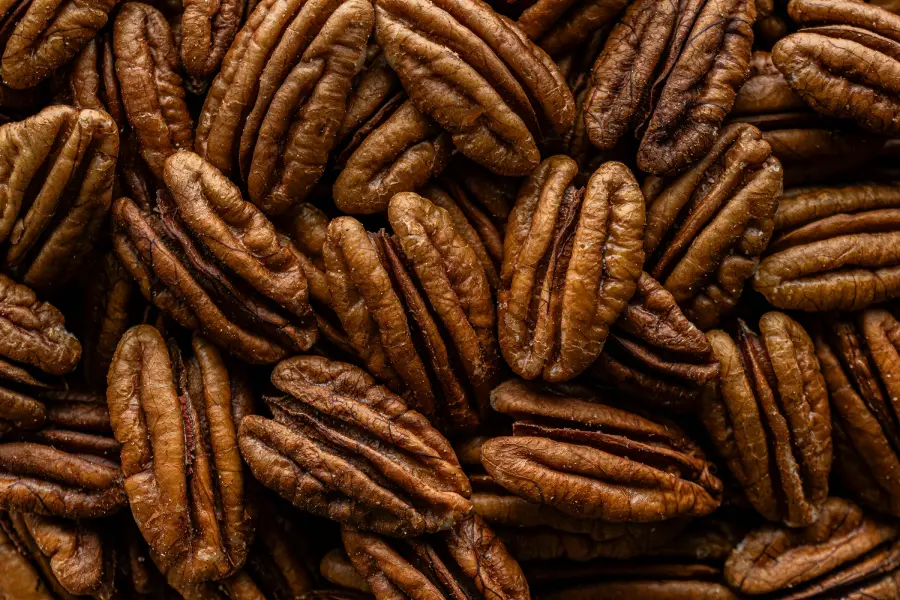
Pecan nuts (Carya illinoinensis) are a high-fat tree nut used in confectionery, bakery, snack bars, and dairy-free spreads. The United States and Mexico together account for roughly 93% of global production. Nutrada lists pecan nut suppliers and manufacturers offering bulk, private label, and organic formats for European buyers, browse the full nuts wholesale category to compare related products.
In short:
Bulk pecans are classified by kernel size, color grade, and format. USDA grading standards, revised in July 2024, define two quality grades: U.S. Extra Fancy and Fancy,.
Size classifications (halves per pound):
| Size | Halves per Pound | Typical Use |
| Mammoth | 250 or fewer | Premium retail, gift packs |
| Junior Mammoth | 251–300 | Snacking, pie toppings, visible applications |
| Jumbo | 301–350 | Bakery, confectionery, granola |
| Extra Large | 351–450 | Ice cream inclusions, coatings |
| Large | 451–550 | Trail mix, chopped applications |
| Medium / Topper | 551+ | Baking, meal production |
Color grades range from golden (highest premium) through light brown, medium brown, to dark brown. Lighter kernels command higher prices for visible applications; darker kernels work well in baking.
Common formats: halves, pieces (large, medium, small), meal/flour, and roasted (oil or dry). Standard bulk packaging is 30 lb (13.6 kg) corrugated boxes. Vacuum-sealed or nitrogen-flushed packaging extends shelf life, critical given pecans’ high oil content (approximately 72% fat).
United States: The largest global producer. Georgia, New Mexico, and Texas are the primary growing states. U.S. processors set the benchmark for grading and quality standards. Common cultivars include Desirable, Stuart, Western Schley, and Wichita.
Mexico: The second-largest producer, with Chihuahua as the main growing region. Mexican pecans are competitively priced. Many processors now hold GFSI-recognized food safety certifications suitable for European export.
South Africa: The third-largest and fastest-growing origin, with kernel output surging 35% in 2024/2025. South African harvest runs March–June, providing counter-seasonal supply that complements Northern Hemisphere availability.
In our experience trading nuts for over a decade, buyers who don’t confirm crop year upfront often end up paying carry-over prices for product that’s already lost freshness. Always ask whether you’re being quoted on current-crop or old stock, with pecans, that distinction matters more than with most other tree nuts because of their high oil content.
Suppliers on Nutrada offer private label pecan packaging in retail formats, typically 150 g, 250 g, 500 g, and 1 kg pouches or resealable bags. Private label pecans are positioned in the premium nut segment, competing with macadamia and pine nuts on shelf appeal.
MOQs typically start around a few hundred kilograms pallet for standard products, with higher minimums for custom roasting, flavoring, or retail packaging runs.
Organic pecans are certified under EU Organic Regulation (EU) 2018/848 or USDA NOP. Supply is limited with organic orchards being concentrated in the U.S. (primarily New Mexico and Texas) and Mexico. Organic pecans carry a price premium over conventional product.
Buyers sourcing organic pecans should confirm dual certification (EU + USDA) if selling across both markets, and request a valid Certificate of Inspection (COI) for each shipment.
Aflatoxin levels: EU Regulation (EU) 2023/915 sets maximum limits at 10 µg/kg total aflatoxins for tree nuts placed on the market for direct consumption. Almonds, pistachios, and hazelnuts have stricter limits; pecans fall under the general tree nut category. Request a Certificate of Analysis (CoA) from an accredited laboratory.
Moisture content: Shelled pecans should be below 4.5% moisture. Higher levels accelerate rancidity and mold development.
Freshness indicators: Request the peroxide value (indicates oxidation level) and ensure packaging is vacuum-sealed or nitrogen-flushed. Storage should be below 4°C for extended shelf life.
Crop year: Pecan trees are alternate bearers, meaning they naturally cycle between heavy and light crop years. Hurricane Helene in 2024 damaged 48,000 acres of orchards in Georgia alone, reducing the U.S. crop by an estimated 36 million pounds. Always confirm the crop year and whether pricing reflects current or carry-over stock.
USDA size classifications range from Mammoth (250 or fewer halves per pound) to Topper (651+). Junior Mammoth (251–300 halves/lb) is the most commonly traded size for food manufacturing. Sizes are measured using standardized round-hole screens.
Shelled pecans in vacuum-sealed or nitrogen-flushed packaging last 12–18 months at temperatures below 4°C. In-shell pecans can last up to 24 months under proper cold storage. At room temperature, quality deteriorates within a few months due to oxidation.
Pecan trees are alternate bearers, they naturally produce a heavy crop one year and a lighter crop the next, with output swings of up to 60%. Weather events amplify this.
At minimum, verify a GFSI-recognized food safety certification (BRC, IFS, or FSSC 22000), an aflatoxin CoA meeting EU limits under Regulation (EU) 2023/915, and phytosanitary documentation. For organic products, confirm EU Organic certification with a valid COI per shipment.
Yes. South Africa’s kernel output surged 35% in 2024/2025, making it the third-largest global producer. Its March–June harvest offers counter-seasonal supply for European buyers. Most South African exports currently go to China, but European demand is increasing.

Find the right supplier for your food ingredients in under a minute with Nutrada. Nutrada - Sourcing made easy.
